Pages

Sunday, February 8, 2009

Pong (Game)

Pong (marketed as PONG) is one of the earliest arcade video games, and is a tennis sports game featuring simple two-dimensional graphics. While other arcade video games such as Computer Space came before it, Pong was one of the first video games to reach mainstream popularity. The aim is to defeat your opponent in a simulated table tennis game by earning a higher score. The game was originally manufactured by Atari Incorporated (Atari), who released it in 1972. Pong was created by Allan Alcorn as a training exercise assigned to him by Atari co-founder Nolan Bushnell. Bushnell based the idea on an electronic ping-pong game included in the Magnavox Odyssey, which later resulted in a lawsuit against Atari. Surprised by the quality of Alcorn's work, Atari decided to manufacture the game.
Pong quickly became a success and is the first commercially successful video game, which led to the start of the video game industry. Soon after its release, several companies began producing games that copied Pong's gameplay, and eventually released new types of games. As a result, Atari encouraged its staff to produce more innovative games. Several sequels were released that built upon the original's gameplay by adding new features. During the 1975 Christmas season, Atari released a home version of Pong exclusively through Sears retail stores. It was also a commercial success and led to numerous copies. The game has been remade on numerous home and portable platforms following its release. Pong has been referenced and parodied in multiple television shows and video games, and has been a part of several video game and cultural exhibitions.

Gameplay
The two paddles return the ball back and forth. The score is kept by the numbers (0 and 1) at the top of the screen.

Pong is a two-dimensional sports game which simulates table tennis. The player controls an in-game paddle by moving it vertically across the left side of the screen, and can compete against either a computer controlled opponent or another player controlling a second paddle on the opposing side. Players use the paddles to hit a ball back and forth. The aim is for a player to earn more points than the opponent; points are earned when one fails to return the ball to the other.

Development and history
Atari engineer Allan Alcorn designed and built Pong as a training exercise.

Pong was the first game developed by Atari Inc., founded in June 1972 by Nolan Bushnell and Ted Dabney. After producing Computer Space, Bushnell decided to form a company to produce more games by licensing ideas to other companies. Their first contract was with Bally Technologies for a driving game. Soon after the founding, Bushnell hired Allan Alcorn because of his experience with electrical engineering and computer science; Bushnell and Dabney also had previously worked with him at Ampex. Prior to working at Atari, Alcorn had no experience with video games. To acclimate Alcorn to creating games, Bushnell gave him a project secretly meant to be a warm-up exercise. Bushnell told Alcorn that he had a contract with General Electric for a product, and asked Alcorn to create a simple game with one moving spot, two paddles, and digits for score keeping. The project was inspired by a game included in the first video game console, the Magnavox Odyssey—in May 1972, Bushnell had visited the Magnavox Profit Caravan in Burlingame, California where he played the Magnavox Odyssey demonstration, specifically the table tennis game.
Alcorn first examined Bushnell's schematics for Computer Space, but found them to be illegible. He went on to create his own designs based on his knowledge of transistor–transistor logic and Bushnell's game. Feeling the basic game was too boring, Alcorn added features to give the game more appeal. He divided the paddle into eight segments to change the ball's angle of return. For example, the center segments return the ball a 90° angle in relation to the paddle, while the outer segments return the ball at smaller angles. He also made the ball accelerate the more it was returned back and forth between paddles; missing the ball reset the speed. Another feature was that the in-game paddles could not reach the top of screen. This was caused by a simple circuit which had an inherent defect. Instead of dedicating time to fixing the defect, Alcorn decided it gave the game more difficulty and helped limit the time the game could be played; he imagined two skilled players being able to play forever otherwise.
Three months into development, Bushnell told Alcorn he wanted the game to feature realistic sound effects and a roaring crowd. Dabney also wanted the game to "boo" and "hiss" when a player lost a round. Alcorn was running out of room on the circuit board and did not know how to create such sounds with digital circuits. After inspecting the sync generator, he discovered it could generate different tones and used those for the game's sound effects. To construct the prototype, Alcorn purchased a black and white television set from a local store, placed it into a 4 feet (1.2 m) wooden cabinet, and soldered the wires into boards to create the necessary circuitry. The prototype impressed Bushnell and Dabney so much that they felt it could be a profitable product and decided to test its marketability.

Atari had established a pinball route consisting of local businesses to generate steady income. In September 1972, Bushnell and Alcorn installed the Pong prototype at a local bar, Andy Capp's Tavern; they selected the bar because of their good working relation with the bar's manager, Bill Gaddis. They placed the prototype on one of the tables near the other entertainment machines: a jukebox, pinball machines, and Computer Space. The game was well received the first night and its popularity continued to grow over the next one and a half weeks. Bushnell then went on a business trip to Chicago to demonstrate Pong to executives at Bally and Midway Manufacturing; he intended to use Pong to fulfill his contract with Bally, rather than the driving game. A few days later, the prototype began exhibiting complications and Gattis contacted Alcorn to fix it. Upon inspecting the machine, Alcorn discovered the mechanisms had jammed from an overflow of quarters.
After hearing about the game's success, Bushnell decided there would be more profit for Atari to manufacture the game rather than license it, but the interest of Bally and Midway had already been piqued. Bushnell decided to inform each of the two groups that the other was not interested—Bushnell told the Bally executives that the Midway executives did not want it and vice versa—to preserve the relationships for future dealings. Upon hearing this, the two groups declined Bushnell's offer. Bushnell had difficulty finding financial backing for Pong; banks viewed it as a variant of pinball, which at the time the general public associated with the Mafia. Atari eventually obtained a line of credit from Wells Fargo that it used to expand their facilities to house an assembly line. Management sought assembly workers at the local unemployment office, but was unable to keep up with demand. The first arcade cabinets produced were assembled very slowly, about ten machines a day, many of which failed quality testing. Atari eventually streamlined the process and began producing the game in greater quantities. By 1973, they began shipping Pong to other countries with the aid of foreign partners.

Thursday, February 5, 2009

Bomberman (Game)

Bomberman is a strategic, maze-based computer and video game franchise originally developed by Hudson Soft. The original game was published in 1983 and new games in the series are still being published to this day. Today, Bomberman is featured in over 70 different games. Being commercially successful, with over 10 million units of games sold, the series "has since become known as the first name in multiplayer games", despite older games being capable of holding more than two players at the same time (like Atari 2600's Warlords, released on 1980, that features 4-players gameplay).

Story
The games are set somewhere in a galaxy known as the Bomber Nebula, on Planet Bomber. The original MSX game (as well as the PS1 version) had no real storyline. The NES and Game Boy versions begin with "Bomberman" (the eponymous character of the game) growing bored of making bombs in an underground factory of the Bungeling Empire. After hearing a rumor that robots reaching the surface become human, he decides to escape. When he does, he transforms and becomes known as the "Runner." This storyline was discontinued (outside of possibly Act Zero). In the Turbografx-16 game, Bomberman is instead the first robot of his kind created by Dr. Mimori. Despite being a prototype, he accepts his role as a defender of justice.
To distinguish him from other Bombermen, the main character is also given the name White Bomberman (or Shirobon). In earlier appearances, the second Bomberman model (known as Black Bomberman) is an enemy due to a programming error, but starting with Super Bomberman the two have forged an alliance. They have joined forces to handle bigger threats, most notably the evil alien Bagulaa (also spelled Bagular, Burglar or Bugler), who is most infamously known as the creator of the Five Dastardly Bombers. Paths were also crossed with an intergalactic crime organization called the Hige-Hige Bandits (led by Mujoe and MechaDoc), as well as a mysterious rival known as Regulus. There is no central series antagonist, but these are the most common.
Bomberman appears to be part of an intergalactic police force to help protect the galaxy. This has been elaborated upon in later games, where a friendly figure named Dr. Ein directs Bomberman's objectives. There is also Bomber Base on Planet Bomber, where Bomberman trains daily. After the shapeshifter (if fed) Pommy was introduced, Charaboms became a part of the gameplay in some later single player games. A Bomberman model called Max also became a semi-regular member of the crew, seemingly replacing Black Bomberman in those appearances.
In the Bomberman Land series, he takes on the name Cheerful White and is paired with Bookworm Green, Kid Blue, Cute Pink, Giant Gold and Cool Black.

Gameplay
The general goal throughout the series is to complete the levels by strategically placing bombs in order to kill enemies and destroy obstacles. Exploding bombs can set off other bombs, kill or injure enemies and destroy obstacles. However, they can also kill or injure the player character, destroy powerups, and sometimes "anger" the exit, causing it to generate more enemies. Most Bomberman games also feature a multiplayer mode, where other Bombermen act as opponents, and the last one standing is the winner. In this mode, powerups are plentiful. Although most games in the Bomberman series use the same type of maze-based levels established by the original game, some are Zelda-like adventure games, Mario-like platformers, Tetris-like puzzle games, and kart racers. It is considered to be a classic franchise by many video game players.

Main Characters


Bomberman, also referred to as "White Bomberman", "White Bomber", "Cheerful White" in (Bomberman Land Touch!), "Bomber John" (in Bomberman Touch), and (in Japan) Shirobon, is the hero of the series. In the standard games, he is the protagonist and player-character. He is usually portrayed as the heroic yet cheerful type, often saving his home planet from disaster. Like all Bombermen, he has the ability to generate bombs in his hands. In later games, such as Bomberman Max and Bomberman Tournament, he is shown to be part of an interplanetary police force stationed at Bomber Base. The White Bomberman also made appearances in other games, such as Wario Blast, a Bomberman game featuring Nintendo mascot Mario's rival, Wario (although that was not the case in Japan). He also appears in DreamMix TV World Fighters—a Hudson fighting game with characters from Hudson Soft, Konami, and Takara. He even make a giant playable appearance in Star Parodier, a spoof of the Star Soldier series, which is also developed by Hudson Soft. He has been featured in three anime series; Bomberman B-Daman Bakugaiden and Bomberman B-Daman Bakugaiden Victory are based on the marble shooting game B-Daman while Bomberman Jetters is inspired by the video game of the same name.
Black Bomberman (Cool Black in Bomberman Land Touch!) looks identical to Bomberman, only he is colored black. In many of his first appearances, he was shown to be the main rival of Bomberman, often performing acts such as robbing banks to fight him. He eventually becomes a gradual friend of Bomberman, and acts as the second player in the two-player story modes of the games. Hudson has given him a cool and collected personality in the later games. He also leads Red Bomber, Blue Bomber, Green Bomber and Yellow Bomber.
Max first appears in Bomberman Max as one of the main characters. He is somewhat competitive and arrogant, as shown in that despite the urgency of the mission, he challenges Bomberman to a contest to who can gather the most karabons. Max wears a black suited armor with a helmet that completely hides his face. He is also a playable character in the game Bomberman Jetters, where he joins Bomberman in the fight against the Hige Hige Bandits again, and he is an unlockable character in Bomberman Generation. He is also unlockable in Bomberman 2 DS.
Dr. Ein is a scientist who assists Bomberman. He is eccentric and doesn't seem to show many emotions. He is fat, has white spiky hair, and glasses with spirals covering the lenses. Despite never having a playable appearance, one of the customization sets in Bomberman Live lets Bomberman wear Dr. Ein's lab coat and glasses.
Karabon are small creatures that help Bomberman progress by granting him abilities. First appearing in Bomberman Max, each game featuring Karabon feature a unique set of them. Bomberman often find Karabon trapped in cages, and he can partner with one to use its ability. He can also fuse them together and battle them against others. Pommy is a recurring Karabon, who first appears in Bomberman 64: The Second Attack, where he is a loyal, but cowardly sidekick and a mimic. He is capable of shooting lightning and taking on many different forms.
Louie (also known as Rooi) are kangaroo-like animals with rabbit ears who help Bomberman by letting him ride on their backs. In Super Bomberman 4, they were replaced by various animals, and in Saturn Bomberman by the dinosaur-like Tirra.
The Fiendish Bombers (a.k.a the Five Dastardly Bombers) are a gang of five recurring boss enemies in several games of the series. Magnet Bomber sports a scarf-like cape and has a magnet shape attached to his helmet, and uses bombs that are attracted to his enemies. Golem Bomber is much larger than the others and he utilizes fire bombs. Pretty Bomber is distinguished from her male counterparts by her pink skirt, yellow neckerchief, and the large yellow heart attached to her helmet. She also appears as a close friend to Bomberman in several games, where both White and Black Bomber are attracted to her. Brain Bomber is the engineer of the group, who wears a cloak and has the symbol of a crown on his helmet. He is shorter than the other characters and sometimes floats above the group. Plasma Bomber is the leader. Plasma Bomber wears a neckerchief and has a lightning bolt attached to his helmet that can create electric currents.
Bagura (Bagular in the West) is the main villain in many of the games. He resembles a blue and white, large, elderly man with a bushy white beard, a monocle and a cape. He first appears as the main villain of Bomberman '94, in which he attempts to run a comet-disguised ship into Planet Bomber after throwing it into chaos. He later appears in several games, including Super Bomberman 3, Super Bomberman 4, Bomberman Hero, Bomberman World and Neo Bomberman. In some odd appearances, he is reduced to a brain that wants to rebuild an empire and wants revenge on Bomberman. In the anime, he is the true leader of the Hige Hige Bandits, with Mujoe as his second-in-command. Dr. MechaDoc also serves the group by creating technology, such as the Hige-Hige Bandits, small robotic minions who are very weak and serve under Mujoe.

Sunday, February 1, 2009

Virtual Reality

Virtual reality (VR) is a term that applies to computer-simulated environments that can simulate places in the real world, as well as in imaginary worlds. Most current virtual reality environments are primarily visual experiences, displayed either on a computer screen or through special stereoscopic displays, but some simulations include additional sensory information, such as sound through speakers or headphones. Some advanced, haptic systems now include tactile information, generally known as force feedback, in medical and gaming applications. Furthermore, virtual reality covers remote communication environments which provide virtual presence of users with the concepts of telepresence and telexistence.
Users can interact with a virtual environment or a virtual artifact (VA) either through the use of standard input devices such as a keyboard and mouse, or through multimodal devices such as a wired glove, the Polhemus, and omnidirectional treadmills. The simulated environment can be similar to the real world—for example, in simulations for pilot or combat training—or it can differ significantly from reality, such as in VR games. In practice, it is currently very difficult to create a high-fidelity virtual reality experience, due largely to technical limitations on processing power, image resolution, and communication bandwidth; however, the technology's proponents hope that such limitations will be overcome as processor, imaging, and data communication technologies become more powerful and cost-effective over time.

Virtual reality is often used to describe a wide variety of applications commonly associated with immersive, highly visual, 3D environments. The development of CAD software, graphics hardware acceleration, head mounted displays, database gloves, and miniaturization have helped popularize the notion. In the book The Metaphysics of Virtual Reality by Michael R. Heim, seven different concepts of virtual reality are identified: simulation, interaction, artificiality, immersion, telepresence, full-body immersion, and network communication. The definition still has a certain futuristic romanticism attached. People often identify VR with head mounted displays and data suits.

Terminology and concepts
The term "artificial reality", coined by Myron Krueger, has been in use since the 1970s; however, the origin of the term "virtual reality" can be traced back to the French playwright, poet, actor, and director Antonin Artaud. In his seminal book The Theatre and Its Double (1938), Artaud described theatre as "la réalite virtuelle", a virtual reality "in which characters, objects, and images take on the phantasmagoric force of alchemy's visionary internal dramas". It has been used in The Judas Mandala, a 1982 science-fiction novel by Damien Broderick, where the context of use is somewhat different from that defined above. The earliest use cited by the Oxford English Dictionary is in a 1987 article titled "Virtual reality", but the article is not about VR technology. The concept of virtual reality was popularized in mass media by movies such as Brainstorm and The Lawnmower Man. The VR research boom of the 1990s was accompanied by the non-fiction book Virtual Reality (1991) by Howard Rheingold. The book served to demystify the subject, making it more accessible to less technical researchers and enthusiasts, with an impact similar to that which his book The Virtual Community had on virtual community research lines closely related to VR. Multimedia: from Wagner to Virtual Reality, edited by Randall Packer and Ken Jordan and first published in 2001, explores the term and its history from an avant-garde perspective. Philosophical implications of the concept of VR are systematically discussed in the book Get Real: A Philosophical Adventure in Virtual Reality (1998) by Philip Zhai, wherein the idea of VR is pushed to its logical extreme and ultimate possibility.[citation needed] According to Zhai, virtual reality could be made to have an ontological status equal to that of actual reality. Digital Sensations: Space, Identity and Embodiment in Virtual Reality (1999), written by Ken Hillis, offers a more critical and theoretical academic assessment of the complex set of cultural and political desires and practices culminating in the development of the technology.

Timeline
Virtual reality can trace its roots to the 1860s, when 360-degree art through panoramic murals began to appear. An example of this would be Baldassare Peruzzi's piece titled, Sala delle Prospettive. In the 1920s, vehicle simulators were introduced. Morton Heilig wrote in the 1950s of an "Experience Theatre" that could encompass all the senses in an effective manner, thus drawing the viewer into the onscreen activity. He built a prototype of his vision dubbed the Sensorama in 1962, along with five short films to be displayed in it while engaging multiple senses (sight, sound, smell, and touch). Predating digital computing, the Sensorama was a mechanical device, which reportedly still functions today. Around this time, Douglas Englebart uses computer screens as both input and output devices. In 1966, Tom Furness introduces a visual flight stimulator for the Air Force. In 1968, Ivan Sutherland, with the help of his student Bob Sproull, created what is widely considered to be the first virtual reality and augmented reality (AR) head mounted display (HMD) system. It was primitive both in terms of user interface and realism, and the HMD to be worn by the user was so heavy it had to be suspended from the ceiling. The graphics comprising the virtual environment were simple wireframe model rooms. The formidable appearance of the device inspired its name, The Sword of Damocles. Also notable among the earlier hypermedia and virtual reality systems was the Aspen Movie Map, which was created at MIT in 1977. The program was a crude virtual simulation of Aspen, Colorado in which users could wander the streets in one of three modes: summer, winter, and polygons. The first two were based on photographs—the researchers actually photographed every possible movement through the city's street grid in both seasons—and the third was a basic 3-D model of the city. In the late 1980s, the term "virtual reality" was popularized by Jaron Lanier, one of the modern pioneers of the field. Lanier had founded the company VPL Research in 1985, which developed and built some of the seminal "goggles and gloves" systems of that decade. In 1991, Antonio Medina, a MIT graduate and NASA scientist, designed a virtual reality system to "drive" Mars rovers from Earth in apparent real time despite the substantial delay of Mars-Earth-Mars signals. The system, termed "Computer-Simulated Teleoperation" as published by Rand, is an extension of virtual reality.

Monday, January 26, 2009

Tetris (Game)

Tetris (Russian: Те́трис) is a puzzle video game originally designed and programmed by Alexey Pajitnov in the Soviet Union. It was released on June 6, 1984, while he was working for the Dorodnicyn Computing Centre of the Academy of Science of the USSR in Moscow. He derived its name from the Greek numerical prefix tetra- (all of the game's pieces, known as Tetrominoes, contain four segments) and tennis, Pajitnov's favorite sport.

The Tetris game is a popular use of tetrominoes, the four element special case of polyominoes. Polyominoes have been used in popular puzzles since at least 1907, and the name is given by the mathematician Solomon W. Golomb in 1953. However, even the enumeration of pentominoes is dated to antiquity.
The game (or one of its many variants) is available for nearly every video game console and computer operating system, as well as on devices such as graphing calculators, mobile phones, portable media players, PDAs, Network music players and even as an Easter egg on non-media products like oscilloscopes. It has even inspired Tetris serving dishes and been played on the sides of various buildings, with the record holder for the world's largest fully functional game of Tetris being an effort by Dutch students in 1995 that lit up all 15 floors of the Electrical Engineering department at Delft University of Technology.
While versions of Tetris were sold for a range of 1980s home computer platforms, it was the hugely successful handheld version for the Game Boy launched in 1989 that established the reputation of the game as one of the most popular ever. Electronic Gaming Monthly's 100th issue had Tetris in first place as "Greatest Game of All Time". In 2007, Tetris came in second place in IGN's "100 Greatest Video Games of All Time". It has sold more than 70 million copies. In January 2010, it was announced that Tetris has sold more than 100 million copies for cell phones alone since 2005.

Gameplay
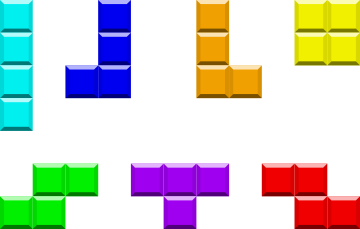
The seven one-sided tetrominoes in their Tetris Worlds colors. Top row, left to right: I, J, L, O. Bottom row: S, T, Z.

A random sequence of tetrominoes (sometimes called "tetrads" in older versions)—shapes composed of four square blocks each—fall down the playing field (a rectangular vertical shaft, called the "well" or "matrix"). The objective of the game is to manipulate these tetrominoes, by moving each one sideways and rotating it by 90 degree units, with the aim of creating a horizontal line of blocks without gaps. When such a line is created, it disappears, and any block above the deleted line will fall. With every ten lines that are cleared, the game enters a new level. As the game progresses, each level causes the tetrominoes to fall faster, and the game ends when the stack of tetrominoes reaches the top of the playing field and no new tetrominoes are able to enter. In certain versions, the game can also end if the player is able to get all the way to level 15.
All of the tetrominoes are capable of single and double clears. I, J, and L are able to clear triples. Only the I tetromino has the capacity to clear four lines simultaneously, and this is referred to as a "tetris". (This may vary depending on the rotation and compensation rules of each specific Tetris implementation. For instance, in the Super Rotation System used in most recent implementations,[16] called "Easy Spin" in Tetris Worlds, certain rare situations allow T, S and Z to 'snap' into tight spots and clear triples.)

Scoring
The scoring formula for the majority of Tetris products is built on the idea that more difficult line clears should be awarded more points. For example, a single line clear in Tetris Zone is worth 100 points, while a back-to-back Tetris is worth 1,200.
Nearly all Tetris games allow the player to press a button to increase the speed of the current piece's descent, rather than waiting for it to fall. If the player can stop the increased speed before the piece reaches the floor by letting go of the button, this is a "soft drop"; otherwise, it is a "hard drop" (some games allow only soft drop or only hard drop; others have separate buttons). Many games award a number of points based on the height that the piece fell before locking.

Gravity
Traditional versions of Tetris move the stacks of blocks down by a distance exactly equal to the height of the cleared rows below them. Contrary to the laws of gravity, blocks may be left floating above gaps. Implementing a different algorithm that uses a flood fill to segment the playfield into connected regions will make each region fall individually, in parallel, until it touches the region at the bottom of the playfield. This opens up additional "chain-reaction" tactics involving blocks cascading to fill additional lines, which may be awarded as more valuable clears.

History
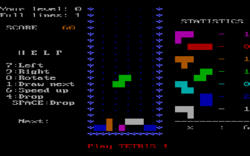
Screenshot of the 1986 IBM PC version

Tetris has been involved in many legal battles. In June 1984, Alexey Pajitnov created Tetris on an Elektronika 60 while working for the Soviet Academy of Sciences at their Computer Center in Moscow with Dmitry Pavlovsky, and Vadim Gerasimov ported it to the IBM PC. Gerasimov reports that Pajitnov chose the name "Tetris" as "a combination of 'tetramino' and 'tennis'." From there, the PC game exploded into popularity, and began spreading all around Moscow. The most recent version of this port is available on Gerasimov's web site.
The IBM PC version eventually made its way to Budapest, Hungary, where it was ported to various platforms and was "discovered" by a British software house named Andromeda. They attempted to contact Pajitnov to secure the rights for the PC version, but before the deal was firmly settled, they had already sold the rights to Spectrum HoloByte. After failing to settle the deal with Pajitnov, Andromeda attempted to license it from the Hungarian programmers instead.
Meanwhile, before any legal rights were settled, the Spectrum HoloByte IBM PC version of Tetris was released in the United States in 1986. The game's popularity was tremendous, and many players were instantly hooked—it was a software blockbuster, with reviews such as in Computer Gaming World calling the game "deceptively simple and insidiously addictive".
The details of the licensing issues were uncertain by this point, but in 1987 Andromeda managed to obtain copyright licensing for the IBM PC version and any other home computer system.
For Amiga and Atari ST two different versions by Spectrum HoloByte and Mirrorsoft became available. The Mirrorsoft version did not feature any background graphics while the Holobyte version had a background picture related to Russian themes for each level. Games were sold as budget titles due to the game's simplicity. Spectrum's Apple II package actually contained three diskettes with three different versions of the game, for the Apple II+ and Apple IIe on separate DOS 3.3 and ProDOS 5-1/4" diskettes, and for the Apple IIgs on a 3-1/2" diskette, none of which was copy-protected: the included documentation specifically charged the purchaser on his or her honor to not give away or copy the extra diskettes.
By 1988, the Soviet government began to market the rights to Tetris through an organization called Elektronorgtechnica, or "Elorg" for short. Pajitnov had granted his rights to the Soviet Government, via the Computer Center he worked at for ten years.[24] By this time Elorg had still seen no money from Andromeda, and yet Andromeda was licensing and sub-licensing rights that they themselves did not even have.