Pages

Thursday, March 12, 2009

Wii

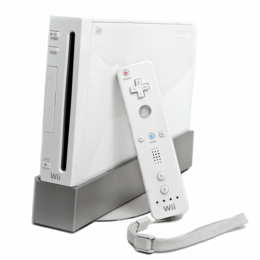
The Wii (pronounced /ˈwiː/, like the pronoun we) is a home video game console released by Nintendo on November 19, 2006. As a seventh-generation console, the Wii primarily competes with Microsoft's Xbox 360 and Sony's PlayStation 3. Nintendo states that its console targets a broader demographic than that of the two others. As of December 2010, the Wii leads the generation over the PlayStation 3 and Xbox 360 in worldwide sales, and in December 2009 broke the record for best-selling console in a single month in the United States.
A distinguishing feature of the console is its wireless controller, the Wii Remote, which can be used as a handheld pointing device and detects movement in three dimensions. Another distinctive feature of the console is WiiConnect24, which enables it to receive messages and updates over the Internet while in standby mode.
The Wii is Nintendo's fifth home console, the direct successor to the Nintendo GameCube, and able to play all official GameCube games. Nintendo first spoke of the console at the 2004 E3 press conference and later unveiled the system at the 2005 E3. Nintendo CEO Satoru Iwata revealed a prototype of the controller at the September 2005 Tokyo Game Show. At E3 2006, the console won the first of several awards. By December 8, 2006, it had completed its launch in four key markets.
History
The console was conceived in 2001, as the Nintendo GameCube was first seeing release. According to an interview with Nintendo's game designer Shigeru Miyamoto, the concept involved focusing on a new form of player interaction. "The consensus was that power isn't everything for a console. Too many powerful consoles can't coexist. It's like having only ferocious dinosaurs. They might fight and hasten their own extinction."
Two years later, engineers and designers were brought together to develop the concept further. By 2005, the controller interface had taken form, but a public showing at that year's Electronic Entertainment Expo (E3) was withdrawn. Miyamoto stated that, "[W]e had some troubleshooting to do. So we decided not to reveal the controller and instead we displayed just the console." Nintendo president Satoru Iwata later unveiled and demonstrated the Wii Remote at the September Tokyo Game Show.
The Nintendo DS is said to have influenced the Wii design. Designer Ken'ichiro Ashida noted, "We had the DS on our minds as we worked on the Wii. We thought about copying the DS's touch-panel interface and even came up with a prototype." The idea was eventually rejected, with the notion that the two gaming systems would be identical. Miyamoto also expressed that, " if the DS had flopped, we might have taken the Wii back to the drawing board."

Name
The console was known by the code name of "Revolution" until April 27, 2006, immediately prior to E3. The Nintendo Style Guide refers to the console as "simply Wii, not Nintendo Wii", making it the first home console Nintendo has marketed outside of Japan without the company name featured in its trademark. While "Wiis" is a commonly used pluralization of the console, Nintendo has stated that the official plural form is "Wii systems" or "Wii consoles."
Nintendo's spelling of "Wii" with two lower-case "i" characters is meant to resemble two people standing side by side, representing players gathering together, as well as to represent the Wii Remote and Nunchuk. The company has given many reasons for this choice of name since the announcement; however, the best known is:
“ Wii sounds like 'we', which emphasizes that the console is for everyone. Wii can easily be remembered by people around the world, no matter what language they speak. No confusion. No need to abbreviate. Just Wii. ”
Despite Nintendo's justification for the name, some video game developers and members of the press reacted negatively towards the change. They preferred "Revolution" over "Wii" and Forbes expressed fear "that the name would convey a continued sense of 'kidiness' to the console." The BBC reported the day after the name was announced that "a long list of puerile jokes, based on the name," had appeared on the Internet. Nintendo of America's president Reggie Fils-Aime acknowledged the initial reaction and further explained the change:
“ Revolution as a name is not ideal; it's long, and in some cultures, it's hard to pronounce. So we wanted something that was short, to the point, easy to pronounce, and distinctive. That's how 'Wii,' as a console name, was created.”
Nintendo of America's then-Vice President of Corporate Affairs Perrin Kaplan defended its choice of "Wii" over "Revolution" and responded to critics of the name by stating, "Live with it, sleep with it, eat with it, move along with it and hopefully they'll arrive at the same place."

Launch
On September 14, 2006, Nintendo announced release information for Japan, North and South America, Australasia (Oceania), Asia and Europe, including dates, prices, and projected unit distribution numbers. It was announced that the majority of the 2006 shipments would be allotted to the Americas, and that 33 titles would be available in the 2006 launch window. The Wii was launched in the United States on November 19, 2006 at $249.99. It was later launched in the United Kingdom on December 8, 2006 at £179. The UK suffered a widespread shortage of console units as many high-street and online stores were unable to fulfill all pre-orders when it was released. The Wii was launched in South Korea on April 26, 2008 and in Taiwan on July 12, 2008.

Monday, March 9, 2009

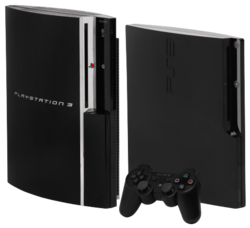
PlayStation 3

The PlayStation 3 (プレイステーション3 Pureisutēshon Surī?, officially abbreviated as PS3) is the third home video game console produced by Sony Computer Entertainment and the successor to the PlayStation 2 as part of the PlayStation series. The PlayStation 3 competes with Microsoft's Xbox 360 and Nintendo's Wii as part of the seventh generation of video game consoles.
A major feature that distinguishes the PlayStation 3 from its predecessors is its unified online gaming service, the PlayStation Network, which contrasts with Sony's former policy of relying on video game developers for online play. Other major features of the console include its robust multimedia capabilities, connectivity with the PlayStation Portable, and its use of the Blu-ray Disc as its primary storage medium. The PS3 was also the first Blu-ray 2.0-compliant Blu-ray player on the market.
The PlayStation 3 was first released on November 11, 2006 in Japan, November 17, 2006 in North America, March 16, 2007 in the United Kingdom and Ireland and March 23, 2007 in mainland Europe and Oceania. Two stock-keeping units were available at launch: a basic model with a 20 GB hard disk drive and a premium model with a 60 GB hard drive and several additional features (the 20 GB model was not released in Europe or Oceania). Since then, several revisions have been made to the console's available models, most notably with the release of a new slim model in September 2009 to coincide with rebranding of the console and its logo.

History
Sony officially unveiled the PlayStation 3 (then marketed as PLAYSTATION 3) to the public along with its original boomerang style controller on May 16, 2005, during the E3 2005 conference. A functional version of the system was not present there, nor at the Tokyo Game Show in September 2005, although demonstrations (such as Metal Gear Solid 4: Guns of the Patriots) were held at both events on software development kits and comparable personal computer hardware. Video footage based on the predicted PlayStation 3 specifications was also shown (notably a Final Fantasy VII tech demo). The initial prototype shown in May 2005 featured two HDMI ports, three Ethernet ports and six USB ports; however, when the system was shown again a year later at E3 2006, these were reduced to one HDMI port, one Ethernet port and four USB ports, presumably to cut costs. Two hardware configurations were also announced for the console: a 20 GB model and a 60 GB model, priced at US$499 (€499) and US$599 (€599), respectively. The 60 GB model was to be the only configuration to feature an HDMI port, Wi-Fi internet, flash card readers and a chrome trim with the logo in silver. Both models were announced for a simultaneous worldwide release: November 11 for Japan and November 17 for North America and Europe.
On September 6, 2006, Sony announced that the PAL region PlayStation 3 launch would be delayed until March 2007, due to a shortage of materials used in the Blu-ray drive.
At the Tokyo Game Show on September 22, 2006, Sony announced that it would include an HDMI port on the 20 GB system, but a chrome trim, flash card readers, silver logo and Wi-Fi would not be included. Also, the launch price of the Japanese 20 GB model was reduced by over 20%, and the 60 GB model was announced for an open pricing scheme in Japan. During the event, Sony showed 27 playable PS3 games running on final hardware.

Launch
The PlayStation 3 was first released in Japan on November 11, 2006 at 07:00. According to Media Create, 81,639 PS3 systems were sold within 24 hours of its introduction in Japan.
Soon after its release in Japan, the PS3 was released in North America on November 17, 2006. Reports of violence surrounding the release of the PS3 include a customer shot, campers robbed at gunpoint, customers shot in a drive-by shooting with BB guns, and 60 campers fighting over 10 systems.
The console was originally planned for a global release through November, but the European and rest-of-the-world's release was delayed "until March" at the start of September. With it being a somewhat last-minute delay, some companies had taken deposit-based pre-orders, to which Sony informed customers that they were eligible for full refunds or could continue the pre-order. On January 24, 2007, Sony announced that the PlayStation 3 would go on sale on March 23, 2007 in Europe, Australia, the Middle East, Africa and New Zealand. The system sold about 600,000 units in its first two days. On March 7, 2007, the 60 GB PlayStation 3 launched in Singapore with a price of S$799. The console was launched in South Korea on June 16, 2007 in a single version equipped with an 80 GB hard drive and IPTV.

PS3 Slim and console rebranding
Following speculation that a 'slim' model was in the pipeline Sony officially announced the PS3 CECH-2000 model on August 18, 2009 at the Sony Gamescom press conference. Among its features are a slimmer form factor and quieter noise when powered on. It was released in major territories by September 2009. As part of the release for the slim model, the logo was changed from the "Spider-Man font" and capitalized PLAYSTATION 3 to a more traditional PlayStation and PlayStation 2 like 'PlayStation 3' logo with "PS3" imprinted on the console. Along with the console and logo redesign, the boot screen of all consoles changed from "Sony Computer Entertainment" to "PS3 PlayStation 3", with a new chime and the game start splashscreen being dropped. The cover art and packaging of games has also been changed to reflect the redesign.

Tuesday, February 24, 2009

Prince of Persia (Game)

Prince of Persia (often shortened to "POP" or "PoP") is a platform game, originally developed by Jordan Mechner and released October 3, 1989 for the Apple II, that represented a great leap forward in the quality of animation seen in computer games. Mechner used a process called rotoscoping, in which he studied many hours of film of his younger brother David running and jumping in white clothes. Also unusual was the method of combat: protagonist and enemies fought with swords, not projectile weapons, as was the case in most contemporary games. Mechner has said that when he started programming, the first ten minutes of Raiders of the Lost Ark had been one of the main inspirations for the character's acrobatic responses in a dangerous environment.
After the original release on the Apple II, Prince of Persia was ported to a wide range of platforms. The game managed to surprise and captivate the player despite being at first glance, repetitive. This was achieved by interspersing intelligent puzzles and deadly traps all along the path the Prince had to take to complete the game — all this packaged in fluid, life-like motion.
Prince of Persia also influenced a sub-genre, which imitated the sprawling non-scrolling levels, fluid animation, and control style pioneered by Prince.

Plot
The game is set in Ancient Persia. While the Sultan is fighting a war in a foreign land, the Grand Vizier Jaffar seizes power. Jaffar's only obstacle to the throne is the Sultan's daughter, the Princess. Jaffar throws her lover into the palace dungeons and locks the Princess in a tower, giving her an ultimatum: she must marry Jaffar or die. She has one hour to decide her fate.
The player controls the Princess's nameless lover. In order to win the game, he must escape the dungeons and make his way to the palace tower, defeating Jaffar and freeing the Princess in under 60 minutes.
The character of Jaffar is loosely based on Ja'far bin Yahya Barmaki, a Persian vizier who was executed for allegedly having an affair with a princess. He is a recurring character in the Arabian Nights and elsewhere in film and literature.

Ports

Mechner used videos of his younger brother, David, as a reference for the original animation for the Apple II version of the game, and copied for the IBM PC version of the game, seen here.
Prince of Persia was originally released for the Apple II in 1989. One year later it was ported to other personal computers such as the Amiga, the Amstrad CPC, the Atari ST, and the PC (DOS). The game was ported in 1991 to the Japanese PC Engine, using the Super CD-ROM format (but got distributed in the US only two years later). In 1992, when the home console market was growing steadily, versions for the Master System, Sega CD, TurboGrafx-CD (the American version of the PC Engine), NES, and Game Boy were released, as well as a version with enhanced artwork for the Macintosh. A Mega Drive/Genesis version followed in 1993 and an enhanced version for the SNES was released later in 1995, with additional levels not present in any other version. Another port was released for the Game Boy Color in 1999. Java versions for mobile devices appeared in the early 2000s. For the revival title, Prince of Persia: The Sands of Time, the Macintosh version was included as a secret that could be unlocked. The first level of the game was also made into a secret 3D minigame in The Sands of Time. The 2010 Wii version of "The Forgotten Sands" included the 3D remake and the SNES version of the original game.
The SAM Coupé version, released in 1992, is unique because it was programmed unofficially using graphics copied pixel by pixel from paused frames of the Amiga version and only shown to Domark (the UK distributors of Prince of Persia) for potential release near completion. Although the computer had a very small user base and no other mainstream support, the release was allowed because of the very high quality of the conversion and the fact that it would incur almost no further development costs. Due to its independently produced status and the fact that the work was done almost entirely by one individual, Chris White, this version of Prince of Persia has several unique bugs.
The PC Engine/TurboGrafx-CD and Sega CD versions used the CD format to incorporate animated cutscenes with voice tracks and CD Audio soundtracks. Both versions of the game had improved graphics that seem to be based on the Macintosh version, where the Princess had a turban and colored clothing.
The Mega Drive/Genesis port also had improved graphics and background music. The Mega Drive version differs with the Genesis version in that it has four additional unique levels and new kinds of potions (some freeze time, others give you additional minutes to complete the game).
The SNES version is also unique. Aside from graphic and aural enhancements, the game has twenty levels instead of the original's thirteen; the original levels that remained had some extra rooms or different routes. Also, there are boss battles, some of which are not the typical swordfighters, and that involves not only swordfighting but dodging as well. The player was also given two hours to rescue the Princess (all other versions were limited to one hour). The prologue is also different, showing the Prince dating the Princess, then being arrested and beaten. The scene of the Prince being beaten is only available on the Japanese version of the game; it was censored in the North American and European versions. The SNES version was ported and developed by NCS and published by Konami in America and Europe.

Tuesday, February 17, 2009

Space Invaders (Game)

Space Invaders​ (スペースインベーダー Supēsu Inbēdā?) is an arcade video game designed by Tomohiro Nishikado, and released in 1978. It was originally manufactured and sold by Taito in Japan, and was later licensed for production in the United States by the Midway division of Bally. Space Invaders is one of the earliest shooting games and the aim is to defeat waves of aliens with a laser cannon to earn as many points as possible. In designing the game, Nishikado drew inspiration from popular media: Breakout, The War of the Worlds, and Star Wars. To complete it, he had to design custom hardware and development tools.
Though simple by today's standards, with basic two-dimensional graphics, it was one of the forerunners of modern video gaming and helped expand the video game industry from a novelty to a global industry. When first released, Space Invaders was very successful and popular. Following its release, the game caused a temporary shortage of 100-yen coins in Japan, and by 2007 had earned Taito US$500 million in revenue. Guinness World Records ranks it the top arcade game.
The game has been the inspiration for other video games, re-released on numerous platforms, and led to several sequels. The 1980 Atari 2600 version quadrupled the system's sales and became the first "killer app" for video game consoles. Space Invaders has been referenced and parodied in multiple television shows, and been a part of several video game and cultural exhibitions. The pixelated enemy alien has become a pop culture icon, often used as a synechdoche representing video games as a whole.

Gameplay

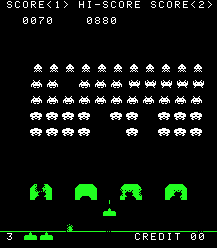
The player-controlled laser cannon shoots the aliens as they descend to the bottom of the screen.
Space Invaders is a two-dimensional fixed shooter game in which the player controls a laser cannon by moving it horizontally across the bottom of the screen and firing at descending aliens. The aim is to defeat five rows of eleven aliens—some versions feature different numbers—that move horizontally back and forth across the screen as they advance towards the bottom of the screen. The player defeats an alien, and earns points, by shooting it with the laser cannon. As more aliens are defeated, the aliens' movement and the game's music both speed up. Defeating the aliens brings another wave that is more difficult, a loop which can continue indefinitely.
The aliens attempt to destroy the cannon by firing at it while they approach the bottom of the screen. If they reach the bottom, the alien invasion is successful and the game ends. A special "mystery ship" will occasionally move across the top of the screen and award bonus points if destroyed. The laser cannon is partially protected by several stationary defense bunkers—the number varies by version—that are gradually destroyed by projectiles from the aliens and player.

Development
Space Invaders was created by Tomohiro Nishikado, who spent a year designing the game and developing the necessary hardware to produce it. The game's inspiration is reported to have come from varying sources, including an adaptation of the mechanical game Space Monsters released by Taito in 1972, and a dream about Japanese school children who are waiting for Santa Claus and are attacked by invading aliens. However, Nishikado has cited Atari's arcade game Breakout as his inspiration. He aimed to create a shooting game that featured the same sense of achievement from completing stages and destroying targets, but with more complex graphics. Nishikado used a similar layout to that of Breakout, but altered the game mechanics. Rather than bounce a ball to attack static objects, players are given the ability to fire projectiles at their own discretion to attack moving enemies.
Early enemy designs included tanks, combat planes, and battleships. Nishikado, however, was not satisfied with the enemy movements; technical limitations made it difficult to simulate flying. Humans would have been easier to simulate, but Nishikado considered shooting them immoral. After seeing a magazine feature about Star Wars, he thought of using a space theme. Nishikado drew inspiration for the aliens from H. G. Wells' The War of the Worlds—he watched a film adaptation as a child—and created initial bitmap images after the octopus-like aliens. Other alien designs were modeled after squids and crabs. The game was originally titled Space Monsters, inspired by a popular song in Japan at the time ("Monster"), but was changed to Space Invaders by Nishikado's superiors.

Hardware
Because microcomputers in Japan were not powerful enough at the time to perform the complex tasks involved in designing and programming Space Invaders, Nishikado had to design his own custom hardware and development tools for the game. He created the arcade board using new microprocessors from the United States. The game uses an Intel 8080 central processing unit, and features raster graphics on a CRT monitor and monaural sound generated by analogue circuitry. Despite the specially developed hardware, Nishikado was unable to program the game as he wanted—the Control Program board was not powerful enough to display the graphics in color or move the enemies faster—and considered the development of the hardware the most difficult part of the whole process. While programming the game, Nishikado discovered that the processor was able to render the alien graphics faster the fewer are on screen. Rather than design the game to compensate for the speed increase, he decided to keep it as a challenging gameplay mechanic.
Space Invaders was first released in a cocktail-table format with black and white graphics, while the Western release by Midway was in an upright cabinet format. The upright cabinet uses strips of orange and green cellophane over the screen to simulate color graphics. The graphics are reflected onto a painted backdrop of a moon against a space background. Later Japanese releases also used colored cellophane. The cabinet artwork features large, humanoid monsters not present in the game. Nishikado attributes this to the artist basing the designs on the original title, Space Monsters, rather than referring to the in-game graphics.