The Xbox 360 is the second video game console produced by Microsoft, and the successor to the Xbox. The Xbox 360 competes with Sony's PlayStation 3 and Nintendo's Wii as part of the seventh generation of video game consoles. Some major features of the Xbox 360 are its integrated Xbox Live service that allows players to compete online, download arcade games, game demos, trailers, TV shows, music and movies and its Windows Media Center multimedia capabilities. The Xbox 360 also offers region specific access to third-party media streaming services such as Netflix and ESPN in the USA or Sky Player in the UK.
The Xbox 360 was officially unveiled on MTV on May 12, 2005, with detailed launch and game information divulged later that month at the Electronic Entertainment Expo (E3). The console sold out completely upon release in all regions except in Japan. As of June 2010, there are over 41.7 million Xbox 360 consoles worldwide.
At their E3 presentation on June 14, 2010, Microsoft announced a redesigned Xbox 360 that would ship on the same day. The redesigned console is slimmer than the previous Xbox 360 model and features integrated 802.11 b/g/n Wi-Fi, TOSLINK S/PDIF optical audio output, 5 USB 2.0 ports (compared to the 3 from older versions) and a special AUX port. Older models of the Xbox 360 have since been discontinued. The first new console to be released features a 250 GB hard drive, while a later, less expensive SKU features 4 GB internal storage.
With the announcement of the Xbox 360 S, Microsoft have said that they believe that the console is only mid-way through its life-cycle and will continue on through 2015. In 2009, IGN named the Xbox 360 the sixth greatest video game console of all time, out of a field of 25.
Development
Known during development as Xbox Next, Xenon, Xbox 2, Xbox FS or NextBox, the Xbox 360 was conceived in early 2003.[18] In February 2003, planning for the Xenon software platform began, and was headed by Microsoft's Vice President J Allard. That month, Microsoft held an event for 400 developers in Bellevue, Washington to recruit support for the system. Also that month, Peter Moore, former president of Sega of America, joined Microsoft. On August 12, 2003, ATI signed on to produce the graphic processing unit for the new console, a deal which was publicly announced two days later. Before the launch of the Xbox 360, several Alpha development kits were spotted using Apple's Power Mac G5 hardware. This was due to the system's PowerPC 970 processor running the same PowerPC architecture that the Xbox 360 would eventually run under IBM's Xenon processor. The cores of the Xenon processor were developed using a slightly modified version of the PlayStation 3's Cell Processor PPE architecture. According to David Shippy and Mickie Phipps, the IBM employees were "hiding" their work from Sony and Toshiba."
Launch
The Xbox 360 was released on November 22, 2005, in the United States and Canada; December 2, 2005, in Europe and December 10, 2005, in Japan. It was later launched in Mexico, Brazil, Chile, Colombia, Hong Kong, Singapore, South Korea, Taiwan, Australia, New Zealand, South Africa, India, and Russia. In its first year on the market, the system launched in 36 countries, more countries than any console has launched in a single year.
Monday, March 16, 2009
Friday, March 13, 2009
Wii Remote
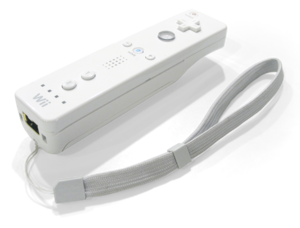
The Wii Remote (Wiiリモコン Uī Rimokon?), sometimes unofficially nicknamed "Wiimote", is the primary controller for Nintendo's Wii console. A main feature of the Wii Remote is its motion sensing capability, which allows the user to interact with and manipulate items on screen via gesture recognition and pointing through the use of accelerometer and optical sensor technology. Another feature is its expandability through the use of attachments. The attachment bundled with the Wii console is the Nunchuk, which complements the Wii Remote by providing functions similar to those in gamepad controllers. Some other attachments include the Wii Classic Controller, Wii Zapper, and the Wii Wheel, originally used for Mario Kart.
The controller was revealed at the Tokyo Game Show on October 14, 2005, with the name "Wii Remote" announced April 27, 2006. It has since received much attention due to its unique features and the contrast between it and typical gaming controllers. It has also gained significant attention from hackers using it to control non Wii-related devices through Wii homebrew.
Development
Development of a motion enabled controller began in 2001, coinciding with development of the Wii console. In that year, Nintendo licensed a number of motion-sensing patents from Gyration Inc., a company that produces wireless motion-sensing computer mice. Nintendo then commissioned Gyration Inc. to create a one-handed controller for it, which eventually developed the "Gyropod", a more traditional gamepad which allowed its right half to break away for motion-control. At this point, Gyration Inc. brought in a separate design firm Bridge Design to help pitch its concept to Nintendo. Under requirement to "roughly preserve the existing Game Cube button layout", it experimented with different forms "through sketches, models and interviewing various hardcore gamers". By "late 2004, early 2005", however, Nintendo had come up with the Wii Remote's less traditional "wand shape", and the design of the Nunchuk attachment. Nintendo had also decided upon using a motion sensor, infrared pointer, and the layout of the buttons, and by the end of 2005 the controller was ready for mass production.
During development of the Wii Remote, video game designer Shigeru Miyamoto brought in mobile phones and controllers for automotive navigation systems for inspiration, eventually producing a prototype that resembled a cell phone. Another design featured both an analog stick and a touchscreen, but Nintendo rejected the idea of a touchscreen on the controller, "since the portable console and living-room console would have been exactly the same".
Sources also indicate that the Wii Remote was originally in development as a controller for the Nintendo GameCube, rather than the Wii. Video game developer Factor 5 stated that during development of launch title Star Wars Rogue Squadron II: Rogue Leader, it had an early prototype of a motion-sensing controller. Video game journalist Matt Casamassina, from gaming website IGN, stated that he believed that Nintendo had planned to release the Wii Remote for the GameCube, noting that "Nintendo said that it hoped that GCN could enjoy a longer life cycle with the addition of top-secret peripherals that would forever enhance the gameplay experience." He suggested that Nintendo may have wanted to release the Wii Remote with a new system, instead of onto the GameCube, as " Revolution addresses one of the GameCube's biggest drawbacks, which is that it was/is perceived as a toy."
Third-party use
Since the release of the Wii console, people have been exploring different new ways in which to use the Wii Remote. Many third-party applications are currently in development through Wii homebrew. One popular Windows program called GlovePIE allows the Wii Remote to be used on a personal computer to emulate a keyboard, mouse or joystick. Connecting the Wii Remote to a personal computer is done via a Bluetooth connection. The Bluetooth program BlueSoleil has been proven to successfully connect a Wii Remote to a PC. Still another program (like GlovePIE) is needed to utilize the Wii Remote's protocol and to use the data it offers.
The Wii Remote Bluetooth protocol can be implemented on other devices including cell phones, which often have poor usability with games. Two students have demonstrated this concept by creating a driver software that has the capability to connect the Wii Remote to a Symbian OS smartphone. The idea behind this driver is that a mobile phone with a TV-out port can replace the game console.
Programmer Johnny Lee has posted video demos and sample code at his website related to the use of the Wii Remote for finger tracking, low-cost multipoint interactive whiteboards, and head tracking for desktop VR displays. This was the subject for his presentation at the prestigious TED conference, where he demonstrated several such applications. The WiimoteProject forum has become the discussion, support and sharing site for Lee's Wii Remote projects and other newer developments.
Studies have also been conducted to use the Wii Remote as a practice method to fine-tune surgeons' hand motions. Utilizing DarwiinRemote, researchers at the University of Memphis have adapted the Wii Remote for data collection in cognitive psychology experiments. Autodesk has released a plugin that allows the Wii Remote to control orientation of 3D models in Autodesk Design Review.
Counterfeit units
As the Wii gained in popularity, reports surfaced of counterfeit Wii Remotes entering circulation. Although these devices may provide the same functionality as official Wii Remotes, the build quality is typically inferior and components such as the rumble pack and speaker are noticeably different. It is also unclear if current and future accessories will operate correctly with counterfeit units due to the differences in internal components.
Design
The Wii Remote assumes a one-handed remote control-based design instead of the traditional gamepad controllers of previous gaming consoles. This was done to make motion sensitivity more intuitive, as a remote design is fitted perfectly for pointing, and in part to help the console appeal to a broader audience that includes non-gamers. The body of the Wii Remote measures 148 mm (5.83 in) long, 36.2 mm (1.43 in) wide, and 30.8 mm (1.21 in) thick. The Wii Remote model number is RVL-003, a reference to the project codename "Revolution". The controller communicates wirelessly with the console via short-range Bluetooth radio, with which it is possible to operate up to four controllers as far as 10 meters (approx. 30 ft) away from the console. However, to utilize pointer functionality, the Wii Remote must be used within five meters (approx. 16 ft) of the Sensor Bar. The controller's symmetrical design allows it to be used in either hand. The Wii Remote can also be turned horizontally and used like a Famicom/NES controller, or in some cases (like Excite Truck, Sonic and the Secret Rings, Mario Kart Wii, and Sonic and Sega All-Stars Racing) a steering wheel. It is also possible to play a single-player game with a Wii Remote in each hand, as in the Shooting Range game contained in Wii Play.
At E3 2006, a few minor changes were made to the controller from the design presented at the Game Developer's Conference. The controller was made slightly longer, and a speaker was added to the face beneath the center row of buttons. The "B" button became more curved resembling a trigger. The "Start" and "Select" buttons were changed to plus "+" and minus "–", and the "b" and "a" buttons were changed to 1 and 2 to differentiate them from the "A" and "B" buttons. Also, the symbol on the "Home" button was changed from a blue dot to a shape resembling a home/house, the shape of the power button was made circular rather than rectangular, and the blue LEDs indicating player number are now labeled using small Braille-like raised dots instead of Arabic numerals, with "1" being "•", "2" being "••", "3" being "•••", and "4" being "••••". The Nintendo logo at the bottom of the controller face was replaced with the Wii logo. Also, the expansion port was redesigned, with expansion plugs featuring a smaller snap-on design.
The blue LEDs also show how much battery power remains on the Wii Remote. By pressing any button, besides the power button while the controller is not being used to play games, a certain number of the four blue LEDs will light up, showing the battery life: four of the LEDs flash when it is at, or near, full power. Three lights flash when it is at 75%, two lights when at 50%, and one light flashes when there is 25% or less power remaining.
Similarities have been noted between the Wii Remote and an early Dreamcast controller prototype.
In the Red Steel trailer shown at E3 2006, the Wii Remote featured a smaller circular shaped image sensor, as opposed to the larger opaque IR filters shown on other versions. In the initial teaser video that revealed the controller at Tokyo Game Show 2005, the 1 and 2 buttons were labeled X and Y, respectively.
The controller was revealed at the Tokyo Game Show on October 14, 2005, with the name "Wii Remote" announced April 27, 2006. It has since received much attention due to its unique features and the contrast between it and typical gaming controllers. It has also gained significant attention from hackers using it to control non Wii-related devices through Wii homebrew.
Development
Development of a motion enabled controller began in 2001, coinciding with development of the Wii console. In that year, Nintendo licensed a number of motion-sensing patents from Gyration Inc., a company that produces wireless motion-sensing computer mice. Nintendo then commissioned Gyration Inc. to create a one-handed controller for it, which eventually developed the "Gyropod", a more traditional gamepad which allowed its right half to break away for motion-control. At this point, Gyration Inc. brought in a separate design firm Bridge Design to help pitch its concept to Nintendo. Under requirement to "roughly preserve the existing Game Cube button layout", it experimented with different forms "through sketches, models and interviewing various hardcore gamers". By "late 2004, early 2005", however, Nintendo had come up with the Wii Remote's less traditional "wand shape", and the design of the Nunchuk attachment. Nintendo had also decided upon using a motion sensor, infrared pointer, and the layout of the buttons, and by the end of 2005 the controller was ready for mass production.
During development of the Wii Remote, video game designer Shigeru Miyamoto brought in mobile phones and controllers for automotive navigation systems for inspiration, eventually producing a prototype that resembled a cell phone. Another design featured both an analog stick and a touchscreen, but Nintendo rejected the idea of a touchscreen on the controller, "since the portable console and living-room console would have been exactly the same".
Sources also indicate that the Wii Remote was originally in development as a controller for the Nintendo GameCube, rather than the Wii. Video game developer Factor 5 stated that during development of launch title Star Wars Rogue Squadron II: Rogue Leader, it had an early prototype of a motion-sensing controller. Video game journalist Matt Casamassina, from gaming website IGN, stated that he believed that Nintendo had planned to release the Wii Remote for the GameCube, noting that "Nintendo said that it hoped that GCN could enjoy a longer life cycle with the addition of top-secret peripherals that would forever enhance the gameplay experience." He suggested that Nintendo may have wanted to release the Wii Remote with a new system, instead of onto the GameCube, as " Revolution addresses one of the GameCube's biggest drawbacks, which is that it was/is perceived as a toy."
Third-party use
Since the release of the Wii console, people have been exploring different new ways in which to use the Wii Remote. Many third-party applications are currently in development through Wii homebrew. One popular Windows program called GlovePIE allows the Wii Remote to be used on a personal computer to emulate a keyboard, mouse or joystick. Connecting the Wii Remote to a personal computer is done via a Bluetooth connection. The Bluetooth program BlueSoleil has been proven to successfully connect a Wii Remote to a PC. Still another program (like GlovePIE) is needed to utilize the Wii Remote's protocol and to use the data it offers.
The Wii Remote Bluetooth protocol can be implemented on other devices including cell phones, which often have poor usability with games. Two students have demonstrated this concept by creating a driver software that has the capability to connect the Wii Remote to a Symbian OS smartphone. The idea behind this driver is that a mobile phone with a TV-out port can replace the game console.
Programmer Johnny Lee has posted video demos and sample code at his website related to the use of the Wii Remote for finger tracking, low-cost multipoint interactive whiteboards, and head tracking for desktop VR displays. This was the subject for his presentation at the prestigious TED conference, where he demonstrated several such applications. The WiimoteProject forum has become the discussion, support and sharing site for Lee's Wii Remote projects and other newer developments.
Studies have also been conducted to use the Wii Remote as a practice method to fine-tune surgeons' hand motions. Utilizing DarwiinRemote, researchers at the University of Memphis have adapted the Wii Remote for data collection in cognitive psychology experiments. Autodesk has released a plugin that allows the Wii Remote to control orientation of 3D models in Autodesk Design Review.
Counterfeit units
As the Wii gained in popularity, reports surfaced of counterfeit Wii Remotes entering circulation. Although these devices may provide the same functionality as official Wii Remotes, the build quality is typically inferior and components such as the rumble pack and speaker are noticeably different. It is also unclear if current and future accessories will operate correctly with counterfeit units due to the differences in internal components.
Design
The Wii Remote assumes a one-handed remote control-based design instead of the traditional gamepad controllers of previous gaming consoles. This was done to make motion sensitivity more intuitive, as a remote design is fitted perfectly for pointing, and in part to help the console appeal to a broader audience that includes non-gamers. The body of the Wii Remote measures 148 mm (5.83 in) long, 36.2 mm (1.43 in) wide, and 30.8 mm (1.21 in) thick. The Wii Remote model number is RVL-003, a reference to the project codename "Revolution". The controller communicates wirelessly with the console via short-range Bluetooth radio, with which it is possible to operate up to four controllers as far as 10 meters (approx. 30 ft) away from the console. However, to utilize pointer functionality, the Wii Remote must be used within five meters (approx. 16 ft) of the Sensor Bar. The controller's symmetrical design allows it to be used in either hand. The Wii Remote can also be turned horizontally and used like a Famicom/NES controller, or in some cases (like Excite Truck, Sonic and the Secret Rings, Mario Kart Wii, and Sonic and Sega All-Stars Racing) a steering wheel. It is also possible to play a single-player game with a Wii Remote in each hand, as in the Shooting Range game contained in Wii Play.
At E3 2006, a few minor changes were made to the controller from the design presented at the Game Developer's Conference. The controller was made slightly longer, and a speaker was added to the face beneath the center row of buttons. The "B" button became more curved resembling a trigger. The "Start" and "Select" buttons were changed to plus "+" and minus "–", and the "b" and "a" buttons were changed to 1 and 2 to differentiate them from the "A" and "B" buttons. Also, the symbol on the "Home" button was changed from a blue dot to a shape resembling a home/house, the shape of the power button was made circular rather than rectangular, and the blue LEDs indicating player number are now labeled using small Braille-like raised dots instead of Arabic numerals, with "1" being "•", "2" being "••", "3" being "•••", and "4" being "••••". The Nintendo logo at the bottom of the controller face was replaced with the Wii logo. Also, the expansion port was redesigned, with expansion plugs featuring a smaller snap-on design.
The blue LEDs also show how much battery power remains on the Wii Remote. By pressing any button, besides the power button while the controller is not being used to play games, a certain number of the four blue LEDs will light up, showing the battery life: four of the LEDs flash when it is at, or near, full power. Three lights flash when it is at 75%, two lights when at 50%, and one light flashes when there is 25% or less power remaining.
Similarities have been noted between the Wii Remote and an early Dreamcast controller prototype.
In the Red Steel trailer shown at E3 2006, the Wii Remote featured a smaller circular shaped image sensor, as opposed to the larger opaque IR filters shown on other versions. In the initial teaser video that revealed the controller at Tokyo Game Show 2005, the 1 and 2 buttons were labeled X and Y, respectively.
Thursday, March 12, 2009
Wii
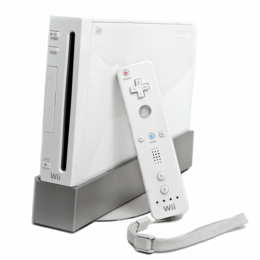
The Wii (pronounced /ˈwiː/, like the pronoun we) is a home video game console released by Nintendo on November 19, 2006. As a seventh-generation console, the Wii primarily competes with Microsoft's Xbox 360 and Sony's PlayStation 3. Nintendo states that its console targets a broader demographic than that of the two others. As of December 2010, the Wii leads the generation over the PlayStation 3 and Xbox 360 in worldwide sales, and in December 2009 broke the record for best-selling console in a single month in the United States.
A distinguishing feature of the console is its wireless controller, the Wii Remote, which can be used as a handheld pointing device and detects movement in three dimensions. Another distinctive feature of the console is WiiConnect24, which enables it to receive messages and updates over the Internet while in standby mode.
The Wii is Nintendo's fifth home console, the direct successor to the Nintendo GameCube, and able to play all official GameCube games. Nintendo first spoke of the console at the 2004 E3 press conference and later unveiled the system at the 2005 E3. Nintendo CEO Satoru Iwata revealed a prototype of the controller at the September 2005 Tokyo Game Show. At E3 2006, the console won the first of several awards. By December 8, 2006, it had completed its launch in four key markets.
History
The console was conceived in 2001, as the Nintendo GameCube was first seeing release. According to an interview with Nintendo's game designer Shigeru Miyamoto, the concept involved focusing on a new form of player interaction. "The consensus was that power isn't everything for a console. Too many powerful consoles can't coexist. It's like having only ferocious dinosaurs. They might fight and hasten their own extinction."
Two years later, engineers and designers were brought together to develop the concept further. By 2005, the controller interface had taken form, but a public showing at that year's Electronic Entertainment Expo (E3) was withdrawn. Miyamoto stated that, "[W]e had some troubleshooting to do. So we decided not to reveal the controller and instead we displayed just the console." Nintendo president Satoru Iwata later unveiled and demonstrated the Wii Remote at the September Tokyo Game Show.
The Nintendo DS is said to have influenced the Wii design. Designer Ken'ichiro Ashida noted, "We had the DS on our minds as we worked on the Wii. We thought about copying the DS's touch-panel interface and even came up with a prototype." The idea was eventually rejected, with the notion that the two gaming systems would be identical. Miyamoto also expressed that, " if the DS had flopped, we might have taken the Wii back to the drawing board."
Name
The console was known by the code name of "Revolution" until April 27, 2006, immediately prior to E3. The Nintendo Style Guide refers to the console as "simply Wii, not Nintendo Wii", making it the first home console Nintendo has marketed outside of Japan without the company name featured in its trademark. While "Wiis" is a commonly used pluralization of the console, Nintendo has stated that the official plural form is "Wii systems" or "Wii consoles."
Nintendo's spelling of "Wii" with two lower-case "i" characters is meant to resemble two people standing side by side, representing players gathering together, as well as to represent the Wii Remote and Nunchuk. The company has given many reasons for this choice of name since the announcement; however, the best known is:
“ Wii sounds like 'we', which emphasizes that the console is for everyone. Wii can easily be remembered by people around the world, no matter what language they speak. No confusion. No need to abbreviate. Just Wii. ”
Despite Nintendo's justification for the name, some video game developers and members of the press reacted negatively towards the change. They preferred "Revolution" over "Wii" and Forbes expressed fear "that the name would convey a continued sense of 'kidiness' to the console." The BBC reported the day after the name was announced that "a long list of puerile jokes, based on the name," had appeared on the Internet. Nintendo of America's president Reggie Fils-Aime acknowledged the initial reaction and further explained the change:
“ Revolution as a name is not ideal; it's long, and in some cultures, it's hard to pronounce. So we wanted something that was short, to the point, easy to pronounce, and distinctive. That's how 'Wii,' as a console name, was created.”
Nintendo of America's then-Vice President of Corporate Affairs Perrin Kaplan defended its choice of "Wii" over "Revolution" and responded to critics of the name by stating, "Live with it, sleep with it, eat with it, move along with it and hopefully they'll arrive at the same place."
Launch
On September 14, 2006, Nintendo announced release information for Japan, North and South America, Australasia (Oceania), Asia and Europe, including dates, prices, and projected unit distribution numbers. It was announced that the majority of the 2006 shipments would be allotted to the Americas, and that 33 titles would be available in the 2006 launch window. The Wii was launched in the United States on November 19, 2006 at $249.99. It was later launched in the United Kingdom on December 8, 2006 at £179. The UK suffered a widespread shortage of console units as many high-street and online stores were unable to fulfill all pre-orders when it was released. The Wii was launched in South Korea on April 26, 2008 and in Taiwan on July 12, 2008.
A distinguishing feature of the console is its wireless controller, the Wii Remote, which can be used as a handheld pointing device and detects movement in three dimensions. Another distinctive feature of the console is WiiConnect24, which enables it to receive messages and updates over the Internet while in standby mode.
The Wii is Nintendo's fifth home console, the direct successor to the Nintendo GameCube, and able to play all official GameCube games. Nintendo first spoke of the console at the 2004 E3 press conference and later unveiled the system at the 2005 E3. Nintendo CEO Satoru Iwata revealed a prototype of the controller at the September 2005 Tokyo Game Show. At E3 2006, the console won the first of several awards. By December 8, 2006, it had completed its launch in four key markets.
History
The console was conceived in 2001, as the Nintendo GameCube was first seeing release. According to an interview with Nintendo's game designer Shigeru Miyamoto, the concept involved focusing on a new form of player interaction. "The consensus was that power isn't everything for a console. Too many powerful consoles can't coexist. It's like having only ferocious dinosaurs. They might fight and hasten their own extinction."
Two years later, engineers and designers were brought together to develop the concept further. By 2005, the controller interface had taken form, but a public showing at that year's Electronic Entertainment Expo (E3) was withdrawn. Miyamoto stated that, "[W]e had some troubleshooting to do. So we decided not to reveal the controller and instead we displayed just the console." Nintendo president Satoru Iwata later unveiled and demonstrated the Wii Remote at the September Tokyo Game Show.
The Nintendo DS is said to have influenced the Wii design. Designer Ken'ichiro Ashida noted, "We had the DS on our minds as we worked on the Wii. We thought about copying the DS's touch-panel interface and even came up with a prototype." The idea was eventually rejected, with the notion that the two gaming systems would be identical. Miyamoto also expressed that, " if the DS had flopped, we might have taken the Wii back to the drawing board."
Name
The console was known by the code name of "Revolution" until April 27, 2006, immediately prior to E3. The Nintendo Style Guide refers to the console as "simply Wii, not Nintendo Wii", making it the first home console Nintendo has marketed outside of Japan without the company name featured in its trademark. While "Wiis" is a commonly used pluralization of the console, Nintendo has stated that the official plural form is "Wii systems" or "Wii consoles."
Nintendo's spelling of "Wii" with two lower-case "i" characters is meant to resemble two people standing side by side, representing players gathering together, as well as to represent the Wii Remote and Nunchuk. The company has given many reasons for this choice of name since the announcement; however, the best known is:
“ Wii sounds like 'we', which emphasizes that the console is for everyone. Wii can easily be remembered by people around the world, no matter what language they speak. No confusion. No need to abbreviate. Just Wii. ”
Despite Nintendo's justification for the name, some video game developers and members of the press reacted negatively towards the change. They preferred "Revolution" over "Wii" and Forbes expressed fear "that the name would convey a continued sense of 'kidiness' to the console." The BBC reported the day after the name was announced that "a long list of puerile jokes, based on the name," had appeared on the Internet. Nintendo of America's president Reggie Fils-Aime acknowledged the initial reaction and further explained the change:
“ Revolution as a name is not ideal; it's long, and in some cultures, it's hard to pronounce. So we wanted something that was short, to the point, easy to pronounce, and distinctive. That's how 'Wii,' as a console name, was created.”
Nintendo of America's then-Vice President of Corporate Affairs Perrin Kaplan defended its choice of "Wii" over "Revolution" and responded to critics of the name by stating, "Live with it, sleep with it, eat with it, move along with it and hopefully they'll arrive at the same place."
Launch
On September 14, 2006, Nintendo announced release information for Japan, North and South America, Australasia (Oceania), Asia and Europe, including dates, prices, and projected unit distribution numbers. It was announced that the majority of the 2006 shipments would be allotted to the Americas, and that 33 titles would be available in the 2006 launch window. The Wii was launched in the United States on November 19, 2006 at $249.99. It was later launched in the United Kingdom on December 8, 2006 at £179. The UK suffered a widespread shortage of console units as many high-street and online stores were unable to fulfill all pre-orders when it was released. The Wii was launched in South Korea on April 26, 2008 and in Taiwan on July 12, 2008.
Monday, March 9, 2009
PlayStation 3
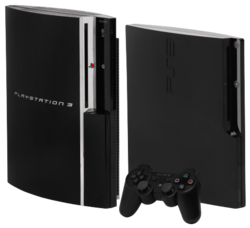
The PlayStation 3 (プレイステーション3 Pureisutēshon Surī?, officially abbreviated as PS3) is the third home video game console produced by Sony Computer Entertainment and the successor to the PlayStation 2 as part of the PlayStation series. The PlayStation 3 competes with Microsoft's Xbox 360 and Nintendo's Wii as part of the seventh generation of video game consoles.
A major feature that distinguishes the PlayStation 3 from its predecessors is its unified online gaming service, the PlayStation Network, which contrasts with Sony's former policy of relying on video game developers for online play. Other major features of the console include its robust multimedia capabilities, connectivity with the PlayStation Portable, and its use of the Blu-ray Disc as its primary storage medium. The PS3 was also the first Blu-ray 2.0-compliant Blu-ray player on the market.
The PlayStation 3 was first released on November 11, 2006 in Japan, November 17, 2006 in North America, March 16, 2007 in the United Kingdom and Ireland and March 23, 2007 in mainland Europe and Oceania. Two stock-keeping units were available at launch: a basic model with a 20 GB hard disk drive and a premium model with a 60 GB hard drive and several additional features (the 20 GB model was not released in Europe or Oceania). Since then, several revisions have been made to the console's available models, most notably with the release of a new slim model in September 2009 to coincide with rebranding of the console and its logo.
History
Sony officially unveiled the PlayStation 3 (then marketed as PLAYSTATION 3) to the public along with its original boomerang style controller on May 16, 2005, during the E3 2005 conference. A functional version of the system was not present there, nor at the Tokyo Game Show in September 2005, although demonstrations (such as Metal Gear Solid 4: Guns of the Patriots) were held at both events on software development kits and comparable personal computer hardware. Video footage based on the predicted PlayStation 3 specifications was also shown (notably a Final Fantasy VII tech demo). The initial prototype shown in May 2005 featured two HDMI ports, three Ethernet ports and six USB ports; however, when the system was shown again a year later at E3 2006, these were reduced to one HDMI port, one Ethernet port and four USB ports, presumably to cut costs. Two hardware configurations were also announced for the console: a 20 GB model and a 60 GB model, priced at US$499 (€499) and US$599 (€599), respectively. The 60 GB model was to be the only configuration to feature an HDMI port, Wi-Fi internet, flash card readers and a chrome trim with the logo in silver. Both models were announced for a simultaneous worldwide release: November 11 for Japan and November 17 for North America and Europe.
On September 6, 2006, Sony announced that the PAL region PlayStation 3 launch would be delayed until March 2007, due to a shortage of materials used in the Blu-ray drive.
At the Tokyo Game Show on September 22, 2006, Sony announced that it would include an HDMI port on the 20 GB system, but a chrome trim, flash card readers, silver logo and Wi-Fi would not be included. Also, the launch price of the Japanese 20 GB model was reduced by over 20%, and the 60 GB model was announced for an open pricing scheme in Japan. During the event, Sony showed 27 playable PS3 games running on final hardware.
Launch
The PlayStation 3 was first released in Japan on November 11, 2006 at 07:00. According to Media Create, 81,639 PS3 systems were sold within 24 hours of its introduction in Japan.
Soon after its release in Japan, the PS3 was released in North America on November 17, 2006. Reports of violence surrounding the release of the PS3 include a customer shot, campers robbed at gunpoint, customers shot in a drive-by shooting with BB guns, and 60 campers fighting over 10 systems.
The console was originally planned for a global release through November, but the European and rest-of-the-world's release was delayed "until March" at the start of September. With it being a somewhat last-minute delay, some companies had taken deposit-based pre-orders, to which Sony informed customers that they were eligible for full refunds or could continue the pre-order. On January 24, 2007, Sony announced that the PlayStation 3 would go on sale on March 23, 2007 in Europe, Australia, the Middle East, Africa and New Zealand. The system sold about 600,000 units in its first two days. On March 7, 2007, the 60 GB PlayStation 3 launched in Singapore with a price of S$799. The console was launched in South Korea on June 16, 2007 in a single version equipped with an 80 GB hard drive and IPTV.
PS3 Slim and console rebranding
Following speculation that a 'slim' model was in the pipeline Sony officially announced the PS3 CECH-2000 model on August 18, 2009 at the Sony Gamescom press conference. Among its features are a slimmer form factor and quieter noise when powered on. It was released in major territories by September 2009. As part of the release for the slim model, the logo was changed from the "Spider-Man font" and capitalized PLAYSTATION 3 to a more traditional PlayStation and PlayStation 2 like 'PlayStation 3' logo with "PS3" imprinted on the console. Along with the console and logo redesign, the boot screen of all consoles changed from "Sony Computer Entertainment" to "PS3 PlayStation 3", with a new chime and the game start splashscreen being dropped. The cover art and packaging of games has also been changed to reflect the redesign.
A major feature that distinguishes the PlayStation 3 from its predecessors is its unified online gaming service, the PlayStation Network, which contrasts with Sony's former policy of relying on video game developers for online play. Other major features of the console include its robust multimedia capabilities, connectivity with the PlayStation Portable, and its use of the Blu-ray Disc as its primary storage medium. The PS3 was also the first Blu-ray 2.0-compliant Blu-ray player on the market.
The PlayStation 3 was first released on November 11, 2006 in Japan, November 17, 2006 in North America, March 16, 2007 in the United Kingdom and Ireland and March 23, 2007 in mainland Europe and Oceania. Two stock-keeping units were available at launch: a basic model with a 20 GB hard disk drive and a premium model with a 60 GB hard drive and several additional features (the 20 GB model was not released in Europe or Oceania). Since then, several revisions have been made to the console's available models, most notably with the release of a new slim model in September 2009 to coincide with rebranding of the console and its logo.
History
Sony officially unveiled the PlayStation 3 (then marketed as PLAYSTATION 3) to the public along with its original boomerang style controller on May 16, 2005, during the E3 2005 conference. A functional version of the system was not present there, nor at the Tokyo Game Show in September 2005, although demonstrations (such as Metal Gear Solid 4: Guns of the Patriots) were held at both events on software development kits and comparable personal computer hardware. Video footage based on the predicted PlayStation 3 specifications was also shown (notably a Final Fantasy VII tech demo). The initial prototype shown in May 2005 featured two HDMI ports, three Ethernet ports and six USB ports; however, when the system was shown again a year later at E3 2006, these were reduced to one HDMI port, one Ethernet port and four USB ports, presumably to cut costs. Two hardware configurations were also announced for the console: a 20 GB model and a 60 GB model, priced at US$499 (€499) and US$599 (€599), respectively. The 60 GB model was to be the only configuration to feature an HDMI port, Wi-Fi internet, flash card readers and a chrome trim with the logo in silver. Both models were announced for a simultaneous worldwide release: November 11 for Japan and November 17 for North America and Europe.
On September 6, 2006, Sony announced that the PAL region PlayStation 3 launch would be delayed until March 2007, due to a shortage of materials used in the Blu-ray drive.
At the Tokyo Game Show on September 22, 2006, Sony announced that it would include an HDMI port on the 20 GB system, but a chrome trim, flash card readers, silver logo and Wi-Fi would not be included. Also, the launch price of the Japanese 20 GB model was reduced by over 20%, and the 60 GB model was announced for an open pricing scheme in Japan. During the event, Sony showed 27 playable PS3 games running on final hardware.
Launch
The PlayStation 3 was first released in Japan on November 11, 2006 at 07:00. According to Media Create, 81,639 PS3 systems were sold within 24 hours of its introduction in Japan.
Soon after its release in Japan, the PS3 was released in North America on November 17, 2006. Reports of violence surrounding the release of the PS3 include a customer shot, campers robbed at gunpoint, customers shot in a drive-by shooting with BB guns, and 60 campers fighting over 10 systems.
The console was originally planned for a global release through November, but the European and rest-of-the-world's release was delayed "until March" at the start of September. With it being a somewhat last-minute delay, some companies had taken deposit-based pre-orders, to which Sony informed customers that they were eligible for full refunds or could continue the pre-order. On January 24, 2007, Sony announced that the PlayStation 3 would go on sale on March 23, 2007 in Europe, Australia, the Middle East, Africa and New Zealand. The system sold about 600,000 units in its first two days. On March 7, 2007, the 60 GB PlayStation 3 launched in Singapore with a price of S$799. The console was launched in South Korea on June 16, 2007 in a single version equipped with an 80 GB hard drive and IPTV.
PS3 Slim and console rebranding
Following speculation that a 'slim' model was in the pipeline Sony officially announced the PS3 CECH-2000 model on August 18, 2009 at the Sony Gamescom press conference. Among its features are a slimmer form factor and quieter noise when powered on. It was released in major territories by September 2009. As part of the release for the slim model, the logo was changed from the "Spider-Man font" and capitalized PLAYSTATION 3 to a more traditional PlayStation and PlayStation 2 like 'PlayStation 3' logo with "PS3" imprinted on the console. Along with the console and logo redesign, the boot screen of all consoles changed from "Sony Computer Entertainment" to "PS3 PlayStation 3", with a new chime and the game start splashscreen being dropped. The cover art and packaging of games has also been changed to reflect the redesign.