Motion tracking or motion capture started as a photogrammetric analysis tool in biomechanics research in the 1970s and 1980s, and expanded into education, training, sports and recently computer animation for television, cinema and video games as the technology matured. A performer wears markers near each joint to identify the motion by the positions or angles between the markers. Acoustic, inertial, LED, magnetic or reflective markers, or combinations of any of these, are tracked, optimally at least two times the frequency rate of the desired motion, to submillimeter positions.
Optical Systems
Optical systems utilize data captured from image sensors to triangulate the 3D position of a subject between one or more cameras calibrated to provide overlapping projections. Data acquisition is traditionally implemented using special markers attached to an actor; however, more recent systems are able to generate accurate data by tracking surface features identified dynamically for each particular subject. Tracking a large number of performers or expanding the capture area is accomplished by the addition of more cameras. These systems produce data with 3 degrees of freedom for each marker, and rotational information must be inferred from the relative orientation of three or more markers; for instance shoulder, elbow and wrist markers providing the angle of the elbow.
Passive markers
Passive optical system use markers coated with a retroreflective material to reflect light back that is generated near the cameras lens. The camera's threshold can be adjusted so only the bright reflective markers will be sampled, ignoring skin and fabric.
The centroid of the marker is estimated as a position within the 2 dimensional image that is captured. The grayscale value of each pixel can be used to provide sub-pixel accuracy by finding the centroid of the Gaussian.
An object with markers attached at known positions is used to calibrate the cameras and obtain their positions and the lens distortion of each camera is measured. Providing two calibrated cameras see a marker, a 3 dimensional fix can be obtained. Typically a system will consist of around 6 to 24 cameras. Systems of over three hundred cameras exist to try to reduce marker swap. Extra cameras are required for full coverage around the capture subject and multiple subjects.
Vendors have constraint software to reduce problems from marker swapping since all markers appear identical. Unlike active marker systems and magnetic systems, passive systems do not require the user to wear wires or electronic equipment. Instead, hundreds of rubber balls are attached with reflective tape, which needs to be replaced periodically. The markers are usually attached directly to the skin (as in biomechanics), or they are velcroed to a performer wearing a full body spandex/lycra suit designed specifically for motion capture. This type of system can capture large numbers of markers at frame rates as high as 2000fps. The frame rate for a given system is often balanced between resolution and speed: a 4-megapixel system normally runs at 370 hertz, but can reduce the resolution to .3 megapixels and then run at 2000 hertz. Typical systems are $100,000 for 4-megapixel 360-hertz systems, and $50,000 for .3-megapixel 120-hertz systems.
Active marker
Active optical systems triangulate positions by illuminating one LED at a time very quickly or multiple LEDs with software to identify them by their relative positions, somewhat akin to celestial navigation. Rather than reflecting light back that is generated externally, the markers themselves are powered to emit their own light. Since Inverse Square law provides 1/4 the power at 2 times the distance, this can increase the distances and volume for capture.
The TV series ("Stargate SG1") episode was produced using an active optical system for the VFX. The actor had to walk around props that would make motion capture difficult for other non-active optical systems.
ILM used active Markers in Van Helsing to allow capture of the Harpies on very large sets. The power to each marker can be provided sequentially in phase with the capture system providing a unique identification of each marker for a given capture frame at a cost to the resultant frame rate. The ability to identify each marker in this manner is useful in realtime applications. The alternative method of identifying markers is to do it algorithmically requiring extra processing of the data.
Time modulated active marker
Active marker systems can further be refined by strobing one marker on at a time, or tracking multiple markers over time and modulating the amplitude or pulse width to provide marker ID. 12 megapixel spatial resolution modulated systems show more subtle movements than 4 megapixel optical systems by having both higher spatial and temporal resolution. Directors can see the actors performance in real time, and watch the results on the mocap driven CG character. The unique marker IDs reduce the turnaround, by eliminating marker swapping and providing much cleaner data than other technologies. LEDs with onboard processing and a radio synchronization allow motion capture outdoors in direct sunlight, while capturing at 480 frames per second due to a high speed electronic shutter. Computer processing of modulated IDs allows less hand cleanup or filtered results for lower operational costs. This higher accuracy and resolution requires more processing than passive technologies, but the additional processing is done at the camera to improve resolution via a subpixel or centroid processing, providing both high resolution and high speed. These motion capture systems are typically under $50,000 for an eight camera, 12 megapixel spatial resolution 480 hertz system with one actor.
Semi-passive imperceptible marker
One can reverse the traditional approach based on high speed cameras. Systems such as Prakash use inexpensive multi-LED high speed projectors. The specially built multi-LED IR projectors optically encode the space. Instead of retro-reflective or active light emitting diode (LED) markers, the system uses photosensitive marker tags to decode the optical signals. By attaching tags with photo sensors to scene points, the tags can compute not only their own locations of each point, but also their own orientation, incident illumination, and reflectance.
These tracking tags that work in natural lighting conditions and can be imperceptibly embedded in attire or other objects. The system supports an unlimited number of tags in a scene, with each tag uniquely identified to eliminate marker reacquisition issues. Since the system eliminates a high speed camera and the corresponding high-speed image stream, it requires significantly lower data bandwidth. The tags also provide incident illumination data which can be used to match scene lighting when inserting synthetic elements. The technique appears ideal for on-set motion capture or real-time broadcasting of virtual sets but has yet to be proven.
Markerless
Emerging techniques and research in computer vision are leading to the rapid development of the markerless approach to motion capture. Markerless systems such as those developed at Stanford, University of Maryland, MIT, and Max Planck Institute, do not require subjects to wear special equipment for tracking. Special computer algorithms are designed to allow the system to analyze multiple streams of optical input and identify human forms, breaking them down into constituent parts for tracking. Applications of this technology extend deeply into popular imagination about the future of computing technology. Several commercial solutions for markerless motion capture have also been introduced. Products currently under development include Microsoft's Kinect system for PC and console systems.
Non-Optical Systems
Inertial systems
Inertial Motion Capture technology is based on miniature inertial sensors, biomechanical models and sensor fusion algorithms. The motion data of the inertial sensors (inertial guidance system) is often transmitted wirelessly to a computer, where the motion is recorded or viewed. Most inertial systems use gyroscopes to measure rotational rates. These rotations are translated to a skeleton in the software. Much like optical markers, the more gyros the more natural the data. No external cameras, emitters or markers are needed for relative motions. Inertial mocap systems capture the full six degrees of freedom body motion of a human in real-time. Benefits of using Inertial systems include: no solving, portability, and large capture areas. Disadvantages include lower positional accuracy and positional drift which can compound over time.
These systems are similar to the Wii controllers but are more sensitive and have greater resolution and update rates. They can accurately measure the direction to the ground to within a degree. The popularity of inertial systems is rising amongst independent game developers, mainly because of the quick and easy set up resulting in a fast pipeline. A range of suits are now available from various manufacturers and base prices range from $25,000 to $80,000 USD.
Mechanical motion
Mechanical motion capture systems directly track body joint angles and are often referred to as exo-skeleton motion capture systems, due to the way the sensors are attached to the body. Performers attaches the skeletal-like structure to their body and as they move so do the articulated mechanical parts, measuring the performer’s relative motion. Mechanical motion capture systems are real-time, relatively low-cost, free-of-occlusion, and wireless (untethered) systems that have unlimited capture volume. Typically, they are rigid structures of jointed, straight metal or plastic rods linked together with potentiometers that articulate at the joints of the body. These suits tend to be in the $25,000 to $75,000 range plus an external absolute positioning system.
Magnetic systems
Magnetic systems calculate position and orientation by the relative magnetic flux of three orthogonal coils on both the transmitter and each receiver. The relative intensity of the voltage or current of the three coils allows these systems to calculate both range and orientation by meticulously mapping the tracking volume. The sensor output is 6DOF, which provides useful results obtained with two-thirds the number of markers required in optical systems; one on upper arm and one on lower arm for elbow position and angle. The markers are not occluded by nonmetallic objects but are susceptible to magnetic and electrical interference from metal objects in the environment, like rebar (steel reinforcing bars in concrete) or wiring, which affect the magnetic field, and electrical sources such as monitors, lights, cables and computers. The sensor response is nonlinear, especially toward edges of the capture area. The wiring from the sensors tends to preclude extreme performance movements. The capture volumes for magnetic systems are dramatically smaller than they are for optical systems. With the magnetic systems, there is a distinction between “AC” and “DC” systems: one uses square pulses, the other uses sine wave pulse.
Sunday, April 5, 2009
Thursday, April 2, 2009
Motion Capture
Motion capture, motion tracking, or mocap are terms used to describe the process of recording movement and translating that movement on to a digital model. It is used in military, entertainment, sports, and medical applications, and for validation of computer vision and robotics. In filmmaking it refers to recording actions of human actors, and using that information to animate digital character models in 2D or 3D computer animation. When it includes face and fingers or captures subtle expressions, it is often referred to as performance capture.
In motion capture sessions, movements of one or more actors are sampled many times per second, although with most techniques (recent developments from Weta use images for 2D motion capture and project into 3D), motion capture records only the movements of the actor, not his/her visual appearance. This animation data is mapped to a 3D model so that the model performs the same actions as the actor. This is comparable to the older technique of rotoscope, such as the 1978 The Lord of the Rings animated film where the visual appearance of the motion of an actor was filmed, then the film used as a guide for the frame-by-frame motion of a hand-drawn animated character.
Camera movements can also be motion captured so that a virtual camera in the scene will pan, tilt, or dolly around the stage driven by a camera operator while the actor is performing, and the motion capture system can capture the camera and props as well as the actor's performance. This allows the computer-generated characters, images and sets to have the same perspective as the video images from the camera. A computer processes the data and displays the movements of the actor, providing the desired camera positions in terms of objects in the set. Retroactively obtaining camera movement data from the captured footage is known as match moving or camera tracking.
Advantages
Motion capture offers several advantages over traditional computer animation of a 3D model:
More rapid, even real time results can be obtained. In entertainment applications this can reduce the costs of keyframe-based animation. For example: Hand Over
The amount of work does not vary with the complexity or length of the performance to the same degree as when using traditional techniques. This allows many tests to be done with different styles or deliveries.
Complex movement and realistic physical interactions such as secondary motions, weight and exchange of forces can be easily recreated in a physically accurate manner.
The amount of animation data that can be produced within a given time is extremely large when compared to traditional animation techniques. This contributes to both cost effectiveness and meeting production deadlines.
Potential for free software and third party solutions reducing its costs.
Disadvantages
Specific hardware and special programs are required to obtain and process the data.
The cost of the software, equipment and personnel required can potentially be prohibitive for small productions.
The capture system may have specific requirements for the space it is operated in, depending on camera field of view or magnetic distortion.
When problems occur it is easier to reshoot the scene rather than trying to manipulate the data. Only a few systems allow real time viewing of the data to decide if the take needs to be redone.
The initial results are limited to what can be performed within the capture volume without extra editing of the data.
Movement that does not follow the laws of physics generally cannot be captured.
Traditional animation techniques, such as added emphasis on anticipation and follow through, secondary motion or manipulating the shape of the character, as with squash and stretch animation techniques, must be added later.
If the computer model has different proportions from the capture subject, artifacts may occur. For example, if a cartoon character has large, over-sized hands, these may intersect the character's body if the human performer is not careful with their physical motion.
In motion capture sessions, movements of one or more actors are sampled many times per second, although with most techniques (recent developments from Weta use images for 2D motion capture and project into 3D), motion capture records only the movements of the actor, not his/her visual appearance. This animation data is mapped to a 3D model so that the model performs the same actions as the actor. This is comparable to the older technique of rotoscope, such as the 1978 The Lord of the Rings animated film where the visual appearance of the motion of an actor was filmed, then the film used as a guide for the frame-by-frame motion of a hand-drawn animated character.
Camera movements can also be motion captured so that a virtual camera in the scene will pan, tilt, or dolly around the stage driven by a camera operator while the actor is performing, and the motion capture system can capture the camera and props as well as the actor's performance. This allows the computer-generated characters, images and sets to have the same perspective as the video images from the camera. A computer processes the data and displays the movements of the actor, providing the desired camera positions in terms of objects in the set. Retroactively obtaining camera movement data from the captured footage is known as match moving or camera tracking.
Advantages
Motion capture offers several advantages over traditional computer animation of a 3D model:
More rapid, even real time results can be obtained. In entertainment applications this can reduce the costs of keyframe-based animation. For example: Hand Over
The amount of work does not vary with the complexity or length of the performance to the same degree as when using traditional techniques. This allows many tests to be done with different styles or deliveries.
Complex movement and realistic physical interactions such as secondary motions, weight and exchange of forces can be easily recreated in a physically accurate manner.
The amount of animation data that can be produced within a given time is extremely large when compared to traditional animation techniques. This contributes to both cost effectiveness and meeting production deadlines.
Potential for free software and third party solutions reducing its costs.
Disadvantages
Specific hardware and special programs are required to obtain and process the data.
The cost of the software, equipment and personnel required can potentially be prohibitive for small productions.
The capture system may have specific requirements for the space it is operated in, depending on camera field of view or magnetic distortion.
When problems occur it is easier to reshoot the scene rather than trying to manipulate the data. Only a few systems allow real time viewing of the data to decide if the take needs to be redone.
The initial results are limited to what can be performed within the capture volume without extra editing of the data.
Movement that does not follow the laws of physics generally cannot be captured.
Traditional animation techniques, such as added emphasis on anticipation and follow through, secondary motion or manipulating the shape of the character, as with squash and stretch animation techniques, must be added later.
If the computer model has different proportions from the capture subject, artifacts may occur. For example, if a cartoon character has large, over-sized hands, these may intersect the character's body if the human performer is not careful with their physical motion.
Friday, March 27, 2009
Stan Lee (Figure)
Stan Lee (born Stanley Martin Lieber; December 28, 1922) is an American comic book writer, editor, actor, producer, publisher, television personality, and the former president and chairman of Marvel Comics.
In collaboration with several artists, most notably Jack Kirby and Steve Ditko, he co-created Spider-Man, the Fantastic Four, the X-Men, the Avengers, Iron Man, the Hulk, Thor, Daredevil, Doctor Strange, and many other fictional characters, introducing complex, naturalistic characters and a thoroughly shared universe into superhero comic books. In addition, he headed the first major successful challenge to the industry's censorship organization, the Comics Code Authority, and forced it to reform its policies. Lee subsequently led the expansion of Marvel Comics from a small division of a publishing house to a large multimedia corporation.
He was inducted into the comic book industry's Will Eisner Comic Book Hall of Fame in 1994 and the Jack Kirby Hall of Fame in 1995.
Early life and career
Lee was born in New York City, New York, in the apartment of his Romanian-born Jewish immigrant parents, Celia (née Solomon) and Jack Lieber, at the corner of West 98th Street and West End Avenue in Manhattan. His father, trained as a dress cutter, worked only sporadically after the Great Depression, and the family moved further uptown to Fort Washington Avenue, in Washington Heights, Manhattan. When Lee was nearly 9, his only sibling, brother Larry Lieber, was born. By the time Lee was in his teens, the family was living in a one-bedroom apartment at 1720 University Avenue in The Bronx. Lee described it as "a third-floor apartment facing out back", with him and his brother sharing a bedroom and his parents using a foldout couch.
Lee attended DeWitt Clinton High School in The Bronx, where his family had moved next. A voracious reader who enjoyed writing as a teen, he worked such part-time jobs as writing obituaries for a news service and press releases for the National Tuberculosis Center; delivering sandwiches for the Jack May pharmacy to offices in Rockefeller Center; working as an office boy for a trouser manufacturer; ushering at the Rivoli Theater on Broadway; and selling subscriptions to the New York Herald Tribune newspaper. He graduated high school early, at age 16½ in 1939, and joined the WPA Federal Theatre Project.
With the help of his uncle, Robbie Solomon, Lee that same year became an assistant at the new Timely Comics division of pulp magazine and comic-book publisher Martin Goodman's company. Timely, by the 1960s, would evolve into Marvel Comics. Lee, whose cousin Jean was Goodman's wife, was formally hired by Timely editor Joe Simon.
His duties were prosaic at first. "In those days dipped the pen in ink, I had to make sure the inkwells were filled", Lee recalled in 2009. "I went down and got them their lunch, I did proofreading, I erased the pencils from the finished pages for them". Marshaling his childhood ambition to be a writer, young Stanley Lieber made his comic-book debut with the text filler "Captain America Foils the Traitor's Revenge" in Captain America Comics #3 (May 1941), using the pseudonym "Stan Lee", which years later he would adopt as his legal name. Lee later explained in his autobiography and numerous other sources that he had intended to save his given name for more literary work. This initial story also introduced Captain America's trademark ricocheting shield-toss, which immediately became one of the character's signatures.
He graduated from writing filler to actual comics with a backup feature, "'Headline' Hunter, Foreign Correspondent", two issues later. Lee's first superhero co-creation was the Destroyer, in Mystic Comics #6 (August 1941). Other characters he created during this period fans and historians call the Golden Age of comics include Jack Frost, debuting in USA Comics #1 (August 1941), and Father Time, debuting in Captain America Comics #6 (August 1941).
When Simon and his creative partner Jack Kirby left late in 1941, following a dispute with Goodman, the 30-year-old publisher installed Lee, just under 19 years old, as interim editor. The youngster showed a knack for the business that led him to remain as the comic-book division's editor-in-chief, as well as art director for much of that time, until 1972, when he would succeed Goodman as publisher.
Lee entered the United States Army in early 1942 and served stateside in the Signal Corps, writing manuals, training films, and slogans, and occasionally cartooning. His military classification, he says, was "playwright"; he adds that only nine men in the U.S. Army were given that title.[19] Vincent Fago, editor of Timely's "animation comics" section, which put out humor and funny animal comics, filled in until Lee returned from his World War II military service in 1945 and rented the top floor of a brownstone in the East 90s in Manhattan.
He married Joan Clayton Boocock on December 5, 1947, and in 1949, the couple bought a two-story, three-bedroom home at 1084 West Broadway in Woodmere, New York, on Long Island, living there through 1952. By this time, the couple had daughter Joan Celia "J.C." Lee, born in 1950; another child, Jan Lee, died three days after delivery in 1953. Lee by this time had bought a home at 226 Richards Lane in the Long Island town of Hewlett Harbor, New York, where he and his family lived from 1952 to 1980, including the 1960s period when Lee and his artist collaborators would revolutionize comic books.
In the mid-1950s, by which time the company was now generally known as Atlas Comics, Lee wrote stories in a variety of genres including romance, Westerns, humor, science fiction, medieval adventure, horror and suspense. By the end of the decade, Lee had become dissatisfied with his career and considered quitting the field.
Marvel revolution
In the late 1950s, DC Comics editor Julius Schwartz revived the superhero archetype and experienced a significant success with its updated version of the Flash, and later with super-team the Justice League of America. In response, publisher Martin Goodman assigned Lee to create a new superhero team. Lee's wife urged him to experiment with stories he preferred, since he was planning on changing careers and had nothing to lose.
Lee acted on that advice, giving his superheroes a flawed humanity, a change from the ideal archetypes that were typically written for pre-teens. His heroes could have bad tempers, melancholy fits, vanity, greed, etc. They bickered amongst themselves, worried about paying their bills and impressing girlfriends, and even were sometimes physically ill. Before him, most superheroes were idealistically perfect people with no serious, lasting problems.
The first superhero group Lee and artist Jack Kirby created was the Fantastic Four. The team's immediate popularity led Lee and Marvel's illustrators to produce a cavalcade of new titles. With Kirby primarily, Lee created the Hulk, Iron Man, Thor and the X-Men; with Bill Everett, Daredevil; and with Steve Ditko, Doctor Strange and Marvel's most successful character, Spider-Man.
Stan Lee's Marvel revolution extended beyond the characters and storylines to the way in which comic books engaged the readership and built a sense of community between fans and creators. Lee introduced the practice of including a credit panel on the splash page of each story, naming not just the writer and penciller but also the inker and letterer. Regular news about Marvel staff members and upcoming storylines was presented on the Bullpen Bulletins page, which (like the letter columns that appeared in each title) was written in a friendly, chatty style.
Throughout the 1960s, Lee scripted, art-directed, and edited most of Marvel's series, moderated the letters pages, wrote a monthly column called "Stan's Soapbox," and wrote endless promotional copy, often signing off with his trademark phrase "Excelsior!" (which is also the New York state motto). To maintain his taxing workload, yet still meet deadlines, he used a system that was used previously by various comic-book studios, but due to Lee's success with it, became known as the "Marvel Method" or "Marvel style" of comic-book creation. Typically, Lee would brainstorm a story with the artist and then prepare a brief synopsis rather than a full script. Based on the synopsis, the artist would fill the allotted number of pages by determining and drawing the panel-to-panel storytelling. After the artist turned in penciled pages, Lee would write the word balloons and captions, and then oversee the lettering and coloring. In effect, the artists were co-plotters, whose collaborative first drafts Lee built upon.
Because of this system, the exact division of creative credits on Lee's comics has been disputed, especially in cases of comics drawn by Kirby and Ditko. Similarly, Lee shares co-creator credit with Kirby on the two Fantastic Four films, while also sharing the same credit with Ditko with the Spider-Man feature film series.
In 1971, Lee indirectly reformed the Comics Code. The US Department of Health, Education and Welfare asked Lee to write a story about the dangers of drugs and Lee wrote a story in which Spider-Man's best friend becomes addicted to pills. The three-part story was slated to be published in Amazing Spider-Man #96-98, but the Comics Code Authority refused it because it depicted drug use; the story context was considered irrelevant. With his publisher's approval, Lee published the comics without the CCA seal. The comics sold well and Marvel won praise for its socially conscious efforts. The CCA subsequently loosened the Code to permit negative depictions of drugs, among other new freedoms.
Lee also supported using comic books to provide some measure of social commentary about the real world, often dealing with racism and bigotry. "Stan's Soapbox", besides promoting an upcoming comic book project, also addressed issues of discrimination, intolerance, or prejudice. In addition, Lee took to using sophisticated vocabulary for the stories' dialogue to encourage readers to learn new words. Lee has justified this by saying: "If a kid has to go to a dictionary, that's not the worst thing that could happen."
In collaboration with several artists, most notably Jack Kirby and Steve Ditko, he co-created Spider-Man, the Fantastic Four, the X-Men, the Avengers, Iron Man, the Hulk, Thor, Daredevil, Doctor Strange, and many other fictional characters, introducing complex, naturalistic characters and a thoroughly shared universe into superhero comic books. In addition, he headed the first major successful challenge to the industry's censorship organization, the Comics Code Authority, and forced it to reform its policies. Lee subsequently led the expansion of Marvel Comics from a small division of a publishing house to a large multimedia corporation.
He was inducted into the comic book industry's Will Eisner Comic Book Hall of Fame in 1994 and the Jack Kirby Hall of Fame in 1995.
Early life and career
Lee was born in New York City, New York, in the apartment of his Romanian-born Jewish immigrant parents, Celia (née Solomon) and Jack Lieber, at the corner of West 98th Street and West End Avenue in Manhattan. His father, trained as a dress cutter, worked only sporadically after the Great Depression, and the family moved further uptown to Fort Washington Avenue, in Washington Heights, Manhattan. When Lee was nearly 9, his only sibling, brother Larry Lieber, was born. By the time Lee was in his teens, the family was living in a one-bedroom apartment at 1720 University Avenue in The Bronx. Lee described it as "a third-floor apartment facing out back", with him and his brother sharing a bedroom and his parents using a foldout couch.
Lee attended DeWitt Clinton High School in The Bronx, where his family had moved next. A voracious reader who enjoyed writing as a teen, he worked such part-time jobs as writing obituaries for a news service and press releases for the National Tuberculosis Center; delivering sandwiches for the Jack May pharmacy to offices in Rockefeller Center; working as an office boy for a trouser manufacturer; ushering at the Rivoli Theater on Broadway; and selling subscriptions to the New York Herald Tribune newspaper. He graduated high school early, at age 16½ in 1939, and joined the WPA Federal Theatre Project.
With the help of his uncle, Robbie Solomon, Lee that same year became an assistant at the new Timely Comics division of pulp magazine and comic-book publisher Martin Goodman's company. Timely, by the 1960s, would evolve into Marvel Comics. Lee, whose cousin Jean was Goodman's wife, was formally hired by Timely editor Joe Simon.
His duties were prosaic at first. "In those days dipped the pen in ink, I had to make sure the inkwells were filled", Lee recalled in 2009. "I went down and got them their lunch, I did proofreading, I erased the pencils from the finished pages for them". Marshaling his childhood ambition to be a writer, young Stanley Lieber made his comic-book debut with the text filler "Captain America Foils the Traitor's Revenge" in Captain America Comics #3 (May 1941), using the pseudonym "Stan Lee", which years later he would adopt as his legal name. Lee later explained in his autobiography and numerous other sources that he had intended to save his given name for more literary work. This initial story also introduced Captain America's trademark ricocheting shield-toss, which immediately became one of the character's signatures.
He graduated from writing filler to actual comics with a backup feature, "'Headline' Hunter, Foreign Correspondent", two issues later. Lee's first superhero co-creation was the Destroyer, in Mystic Comics #6 (August 1941). Other characters he created during this period fans and historians call the Golden Age of comics include Jack Frost, debuting in USA Comics #1 (August 1941), and Father Time, debuting in Captain America Comics #6 (August 1941).
When Simon and his creative partner Jack Kirby left late in 1941, following a dispute with Goodman, the 30-year-old publisher installed Lee, just under 19 years old, as interim editor. The youngster showed a knack for the business that led him to remain as the comic-book division's editor-in-chief, as well as art director for much of that time, until 1972, when he would succeed Goodman as publisher.
Lee entered the United States Army in early 1942 and served stateside in the Signal Corps, writing manuals, training films, and slogans, and occasionally cartooning. His military classification, he says, was "playwright"; he adds that only nine men in the U.S. Army were given that title.[19] Vincent Fago, editor of Timely's "animation comics" section, which put out humor and funny animal comics, filled in until Lee returned from his World War II military service in 1945 and rented the top floor of a brownstone in the East 90s in Manhattan.
He married Joan Clayton Boocock on December 5, 1947, and in 1949, the couple bought a two-story, three-bedroom home at 1084 West Broadway in Woodmere, New York, on Long Island, living there through 1952. By this time, the couple had daughter Joan Celia "J.C." Lee, born in 1950; another child, Jan Lee, died three days after delivery in 1953. Lee by this time had bought a home at 226 Richards Lane in the Long Island town of Hewlett Harbor, New York, where he and his family lived from 1952 to 1980, including the 1960s period when Lee and his artist collaborators would revolutionize comic books.
In the mid-1950s, by which time the company was now generally known as Atlas Comics, Lee wrote stories in a variety of genres including romance, Westerns, humor, science fiction, medieval adventure, horror and suspense. By the end of the decade, Lee had become dissatisfied with his career and considered quitting the field.
Marvel revolution
In the late 1950s, DC Comics editor Julius Schwartz revived the superhero archetype and experienced a significant success with its updated version of the Flash, and later with super-team the Justice League of America. In response, publisher Martin Goodman assigned Lee to create a new superhero team. Lee's wife urged him to experiment with stories he preferred, since he was planning on changing careers and had nothing to lose.
Lee acted on that advice, giving his superheroes a flawed humanity, a change from the ideal archetypes that were typically written for pre-teens. His heroes could have bad tempers, melancholy fits, vanity, greed, etc. They bickered amongst themselves, worried about paying their bills and impressing girlfriends, and even were sometimes physically ill. Before him, most superheroes were idealistically perfect people with no serious, lasting problems.
The first superhero group Lee and artist Jack Kirby created was the Fantastic Four. The team's immediate popularity led Lee and Marvel's illustrators to produce a cavalcade of new titles. With Kirby primarily, Lee created the Hulk, Iron Man, Thor and the X-Men; with Bill Everett, Daredevil; and with Steve Ditko, Doctor Strange and Marvel's most successful character, Spider-Man.
Stan Lee's Marvel revolution extended beyond the characters and storylines to the way in which comic books engaged the readership and built a sense of community between fans and creators. Lee introduced the practice of including a credit panel on the splash page of each story, naming not just the writer and penciller but also the inker and letterer. Regular news about Marvel staff members and upcoming storylines was presented on the Bullpen Bulletins page, which (like the letter columns that appeared in each title) was written in a friendly, chatty style.
Throughout the 1960s, Lee scripted, art-directed, and edited most of Marvel's series, moderated the letters pages, wrote a monthly column called "Stan's Soapbox," and wrote endless promotional copy, often signing off with his trademark phrase "Excelsior!" (which is also the New York state motto). To maintain his taxing workload, yet still meet deadlines, he used a system that was used previously by various comic-book studios, but due to Lee's success with it, became known as the "Marvel Method" or "Marvel style" of comic-book creation. Typically, Lee would brainstorm a story with the artist and then prepare a brief synopsis rather than a full script. Based on the synopsis, the artist would fill the allotted number of pages by determining and drawing the panel-to-panel storytelling. After the artist turned in penciled pages, Lee would write the word balloons and captions, and then oversee the lettering and coloring. In effect, the artists were co-plotters, whose collaborative first drafts Lee built upon.
Because of this system, the exact division of creative credits on Lee's comics has been disputed, especially in cases of comics drawn by Kirby and Ditko. Similarly, Lee shares co-creator credit with Kirby on the two Fantastic Four films, while also sharing the same credit with Ditko with the Spider-Man feature film series.
In 1971, Lee indirectly reformed the Comics Code. The US Department of Health, Education and Welfare asked Lee to write a story about the dangers of drugs and Lee wrote a story in which Spider-Man's best friend becomes addicted to pills. The three-part story was slated to be published in Amazing Spider-Man #96-98, but the Comics Code Authority refused it because it depicted drug use; the story context was considered irrelevant. With his publisher's approval, Lee published the comics without the CCA seal. The comics sold well and Marvel won praise for its socially conscious efforts. The CCA subsequently loosened the Code to permit negative depictions of drugs, among other new freedoms.
Lee also supported using comic books to provide some measure of social commentary about the real world, often dealing with racism and bigotry. "Stan's Soapbox", besides promoting an upcoming comic book project, also addressed issues of discrimination, intolerance, or prejudice. In addition, Lee took to using sophisticated vocabulary for the stories' dialogue to encourage readers to learn new words. Lee has justified this by saying: "If a kid has to go to a dictionary, that's not the worst thing that could happen."
Thursday, March 26, 2009
Spider-Man (Character)
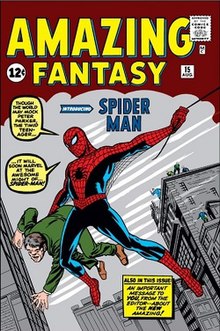
Spider-Man is a fictional Marvel Comics superhero. The character was created by writer-editor Stan Lee and writer-artist Steve Ditko. He first appeared in Amazing Fantasy #15 (Aug. 1962). Lee and Ditko conceived of the character as an orphan being raised by his Aunt May and Uncle Ben, and as a teenager, having to deal with the normal struggles of adolescence in addition to those of a costumed crime fighter. Spider-Man's creators gave him super strength and agility, the ability to cling to most surfaces, shoot spider-webs using devices of his own invention which he called "web-shooters", and react to danger quickly with his "spider-sense", enabling him to combat his foes.
When Spider-Man first appeared in the early 1960s, teenagers in superhero comic books were usually relegated to the role of sidekick to the protagonist. The Spider-Man series broke ground by featuring Peter Parker, a teenage high school student to whose "self-obsessions with rejection, inadequacy, and loneliness" young readers could relate. Unlike previous teen heroes such as James Buchanan "Bucky" Barnes and Robin, Spider-Man did not benefit from being the protégé of any adult mentors like Captain America and Batman, and thus had to learn for himself that "with great power there must also come great responsibility" — a line included in a text box in the final panel of the first Spider-Man story, but later retroactively attributed to his guardian, the late Uncle Ben.
Marvel has featured Spider-Man in several comic book series, the first and longest-lasting of which is titled The Amazing Spider-Man. Over the years, the Peter Parker character has developed from shy, high school student to troubled but outgoing college student, to married high school teacher to, in the late 2000s, a single freelance photographer, his most typical adult role. He is even been a member of an unofficial splinter group of the Avengers, one of Marvel's flagship superhero teams. In the comics, Spider-Man is often referred to as "Spidey," "web-slinger," "wall-crawler," or "web-head."
Spider-Man is one of the most popular and commercially successful superheroes. As Marvel's flagship character and company mascot, he has appeared in many forms of media, including several animated and live-action television shows, syndicated newspaper comic strips, and a successful series of films starring actor Tobey Maguire as the "friendly neighborhood" hero in the first three movies. Andrew Garfield will take over the role of Peter Parker in a planned reboot of the films. Also Reeve Carney will star as Spider-Man in Spider-Man: Turn Off the Dark, the new musical adaptation of the comics.
Creation and Development
In 1962, with the success of the Fantastic Four, Marvel Comics editor and head writer Stan Lee was casting about for a new superhero idea. He said that the idea for Spider-Man arose from a surge in teenage demand for comic books, and the desire to create a character with whom teens could identify. In his autobiography, Lee cites the non-superhuman pulp magazine crime fighter The Spider as a great influence, and in a multitude of print and video interviews, Lee stated he was further inspired by seeing a spider climb up a wall---adding in his autobiography that he has told that story so often he has become unsure of whether or not this is true. Looking back on the creation of Spider-Man, 1990s Marvel editor-in-chief Tom DeFalco stated he did not believe that Spider-Man would have been given a chance in today's comics world, where new characters are vetted with test audiences and marketers. At that time, however, Lee had to get only the consent of Marvel publisher Martin Goodman for the character's approval. In a 1986 interview, Lee described in detail his arguments to overcome Goodman's objections. Goodman eventually agreed to let Lee try out Spider-Man in the upcoming final issue of the canceled science-fiction and supernatural anthology series Amazing Adult Fantasy, which was renamed Amazing Fantasy for that single issue, #15 (Aug. 1962).
Comics historian Greg Theakston says that Lee, after receiving Goodman's approval for the name Spider-Man and the "ordinary teen" concept, approached artist Jack Kirby. Kirby told Lee about an unpublished character on which he collaborated with Joe Simon in the 1950s, in which an orphaned boy living with an old couple finds a magic ring that granted him superhuman powers. Lee and Kirby "immediately sat down for a story conference" and Lee afterward directed Kirby to flesh out the character and draw some pages. Steve Ditko would be the inker. When Kirby showed Lee the first six pages, Lee recalled, "I hated the way he was doing it! Not that he did it badly -- it just wasn't the character I wanted; it was too heroic". Lee turned to Ditko, who developed a visual style Lee found satisfactory. Ditko recalled:
One of the first things I did was to work up a costume. A vital, visual part of the character. I had to know how he looked ... before I did any breakdowns. For example: A clinging power so he wouldn't have hard shoes or boots, a hidden wrist-shooter versus a web gun and holster, etc. ... I wasn't sure Stan would like the idea of covering the character's face but I did it because it hid an obviously boyish face. It would also add mystery to the character....
In an early recollection of the character's creation, Ditko described his and Lee's contributions in a mail interview with Gary Martin published in Comic Fan #2 (Summer 1965): "Stan Lee thought the name up. I did costume, web gimmick on wrist & spider signal." At the time, Ditko shared a Manhattan studio with noted fetish artist Eric Stanton, an art-school classmate who, in a 1988 interview with Theakston, recalled that although his contribution to Spider-Man was "almost nil", he and Ditko had "worked on storyboards together and I added a few ideas. But the whole thing was created by Steve on his own... I think I added the business about the webs coming out of his hands".
Kirby disputed Lee's version of the story, and claimed Lee had minimal involvement in the character's creation. According to Kirby, the idea for Spider-Man had originated with Kirby and Joe Simon, who in the 1950s had developed a character called The Silver Spider for the Crestwood comic Black Magic, who was subsequently not used. Simon, in his 1990 autobiography, disputed Kirby's account, asserting that Black Magic was not a factor, and that he (Simon) devised the name "Spider-Man" (later changed to "The Silver Spider"), while Kirby outlined the character's story and powers. Simon later elaborated that his and Kirby's character conception became the basis for Simon's Archie Comics superhero the Fly. Artist Steve Ditko stated that Lee liked the name Hawkman from DC Comics, and that "Spider-Man" was an outgrowth of that interest. The hyphen was included in the character's name to avoid confusion with DC Comics' Superman.
Simon concurred that Kirby had shown the original Spider-Man version to Lee, who liked the idea and assigned Kirby to draw sample pages of the new character but disliked the results—in Simon's description, "Captain America with cobwebs". Writer Mark Evanier notes that Lee's reasoning that Kirby's character was too heroic seems unlikely—Kirby still drew the covers for the first issues of Spider-Man. Likewise, Kirby's given reason that he was "too busy" to also draw Spider-Man in addition to his other duties seems false, as Kirby was, in Evanier's words, "always busy". Neither Lee's nor Kirby's explanation explains why key story elements like the magic ring were dropped; Evanier states that the most plausible explanation for the sudden change was that Goodman, or one of his assistants, decided that Spider-Man as drawn and envisioned by Kirby was too similar to the Fly.
Author and Ditko scholar Blake Bell writes that it was Ditko who noted the similarities to the Fly. Ditko recalled that, "Stan called Jack about the Fly", adding that "days later, Stan told me I would be penciling the story panel breakdowns from Stan's synopsis". It was at this point that the nature of the strip changed. "Out went the magic ring, adult Spider-Man and whatever legend ideas that Spider-Man story would have contained". Lee gave Ditko the premise of a teenager bitten by a spider and developing powers, a premise Ditko would expand upon to the point he became what Bell describes as "the first work for hire artist of his generation to create and control the narrative arc of his series". On the issue of the initial creation, Ditko states, "I still don't know whose idea was Spider-Man". Kirby noted in a 1971 interview that it was Ditko who "got Spider-Man to roll, and the thing caught on because of what he did". Lee, while claiming credit for the initial idea, has acknowledged Ditko's role, stating, "If Steve wants to be called co-creator, I think he deserves". Writer Al Nickerson believes "that Stan Lee and Steve Ditko created the Spider-Man that we are familiar with today ultimately, Spider-Man came into existence, and prospered, through the efforts of not just one or two, but many, comic book creators".
In 2008, an anonymous donor bequeathed the Library of Congress the original 24 pages of Ditko art of Amazing Fantasy #15, including Spider-Man's debut and the stories "The Bell-Ringer", "Man in the Mummy Case", and "There Are Martians Among Us".
Commercial success
A few months after Spider-Man's introduction in Amazing Fantasy #15 (Aug. 1962), publisher Martin Goodman reviewed the sales figures for that issue and was shocked to find it to have been one of the nascent Marvel's highest-selling comics. A solo ongoing series followed, beginning with The Amazing Spider-Man #1 (March 1963). The title eventually became Marvel's top-selling series with the character swiftly becoming a cultural icon; a 1965 Esquire poll of college campuses found that college students ranked Spider-Man and fellow Marvel hero the Hulk alongside Bob Dylan and Che Guevara as their favorite revolutionary icons. One interviewee selected Spider-Man because he was "beset by woes, money problems, and the question of existence. In short, he is one of us." Following Ditko's departure after issue #38 (July 1966), John Romita, Sr. replaced him as artist, and would provide the pencil drawings of the character over the next several years. In 1968, Romita would also draw the character's extra-length stories in the magazine The Spectacular Spider-Man, a graphic novel precursor designed to appeal to older readers but which lasted only two issues. Nonetheless, it represented the first Spider-Man spin-off publication, aside from the original series' summer annuals that began in 1964.
An early 1970s Spider-Man story led to the revision of the Comics Code. Previously, the Code forbade the depiction of the use of illegal drugs, even negatively. However, in 1970, the Nixon administration's Department of Health, Education, and Welfare asked Stan Lee to publish an anti-drug message in one of Marvel's top-selling titles. Lee chose the top-selling The Amazing Spider-Man; issues #96–98 (May–July 1971) feature a story arc depicting the negative effects of drug use. In the story, Peter Parker's friend Harry Osborn becomes addicted to pills. When Spider-Man fights the Green Goblin (Norman Osborn, Harry's father), Spider-Man defeats the Green Goblin, by revealing Harry's drug addiction. While the story had a clear anti-drug message, the Comics Code Authority refused to issue its seal of approval. Marvel nevertheless published the three issues without the Comics Code Authority's approval or seal. The issues sold so well that the industry's self-censorship was undercut and the Code was subsequently revised.
In 1972, a second monthly ongoing series starring Spider-Man began: Marvel Team-Up, in which Spider-Man was paired with other superheroes and villains. In 1976, his second solo series, The Spectacular Spider-Man began running parallel to the main series. A third series featuring Spider-Man, Web of Spider-Man, launched in 1985, replacing Marvel Team-Up. The launch of a fourth monthly title in 1990, the "adjectiveless" Spider-Man (with the storyline "Torment"), written and drawn by popular artist Todd McFarlane, debuted with several different covers, all with the same interior content. The various versions combined sold over 3 million copies, an industry record at the time. There have generally been at least two ongoing Spider-Man series at any time. Several limited series, one-shots, and loosely related comics have also been published, and Spider-Man makes frequent cameos and guest appearances in other comic series.
The original Amazing Spider-Man ran through issue #441 (Nov. 1998). Writer-artist John Byrne then revamped the origin of Spider-Man in the 13-issue limited series Spider-Man: Chapter One (Dec. 1998 - Oct. 1999, with an issue #0 midway through and some months containing two issues), similar to Byrne's adding details and some revisions to Superman's origin in DC Comics' The Man of Steel. Running concurrently, The Amazing Spider-Man was restarted with vol. 2, #1 (Jan. 1999). With what would have been vol. 2, #59, Marvel reintroduced the original numbering, starting with #500 (Dec. 2003).
By the end of 2007, Spider-Man regularly appeared in The Amazing Spider-Man, New Avengers, Spider-Man Family, and various limited series in mainstream Marvel Comics continuity, as well as in the alternate-universe series The Amazing Spider-Girl, the Ultimate Universe title Ultimate Spider-Man, the alternate-universe tween series Spider-Man Loves Mary Jane, the alternate-universe children's series Marvel Adventures Spider-Man, and Marvel Adventures: The Avengers.
When primary series The Amazing Spider-Man reached issue #545 (Dec. 2007), Marvel dropped its spin-off ongoing series and instead began publishing The Amazing Spider-Man three times monthly, beginning with #546-549 (each Jan. 2008).
When Spider-Man first appeared in the early 1960s, teenagers in superhero comic books were usually relegated to the role of sidekick to the protagonist. The Spider-Man series broke ground by featuring Peter Parker, a teenage high school student to whose "self-obsessions with rejection, inadequacy, and loneliness" young readers could relate. Unlike previous teen heroes such as James Buchanan "Bucky" Barnes and Robin, Spider-Man did not benefit from being the protégé of any adult mentors like Captain America and Batman, and thus had to learn for himself that "with great power there must also come great responsibility" — a line included in a text box in the final panel of the first Spider-Man story, but later retroactively attributed to his guardian, the late Uncle Ben.
Marvel has featured Spider-Man in several comic book series, the first and longest-lasting of which is titled The Amazing Spider-Man. Over the years, the Peter Parker character has developed from shy, high school student to troubled but outgoing college student, to married high school teacher to, in the late 2000s, a single freelance photographer, his most typical adult role. He is even been a member of an unofficial splinter group of the Avengers, one of Marvel's flagship superhero teams. In the comics, Spider-Man is often referred to as "Spidey," "web-slinger," "wall-crawler," or "web-head."
Spider-Man is one of the most popular and commercially successful superheroes. As Marvel's flagship character and company mascot, he has appeared in many forms of media, including several animated and live-action television shows, syndicated newspaper comic strips, and a successful series of films starring actor Tobey Maguire as the "friendly neighborhood" hero in the first three movies. Andrew Garfield will take over the role of Peter Parker in a planned reboot of the films. Also Reeve Carney will star as Spider-Man in Spider-Man: Turn Off the Dark, the new musical adaptation of the comics.
Creation and Development
In 1962, with the success of the Fantastic Four, Marvel Comics editor and head writer Stan Lee was casting about for a new superhero idea. He said that the idea for Spider-Man arose from a surge in teenage demand for comic books, and the desire to create a character with whom teens could identify. In his autobiography, Lee cites the non-superhuman pulp magazine crime fighter The Spider as a great influence, and in a multitude of print and video interviews, Lee stated he was further inspired by seeing a spider climb up a wall---adding in his autobiography that he has told that story so often he has become unsure of whether or not this is true. Looking back on the creation of Spider-Man, 1990s Marvel editor-in-chief Tom DeFalco stated he did not believe that Spider-Man would have been given a chance in today's comics world, where new characters are vetted with test audiences and marketers. At that time, however, Lee had to get only the consent of Marvel publisher Martin Goodman for the character's approval. In a 1986 interview, Lee described in detail his arguments to overcome Goodman's objections. Goodman eventually agreed to let Lee try out Spider-Man in the upcoming final issue of the canceled science-fiction and supernatural anthology series Amazing Adult Fantasy, which was renamed Amazing Fantasy for that single issue, #15 (Aug. 1962).
Comics historian Greg Theakston says that Lee, after receiving Goodman's approval for the name Spider-Man and the "ordinary teen" concept, approached artist Jack Kirby. Kirby told Lee about an unpublished character on which he collaborated with Joe Simon in the 1950s, in which an orphaned boy living with an old couple finds a magic ring that granted him superhuman powers. Lee and Kirby "immediately sat down for a story conference" and Lee afterward directed Kirby to flesh out the character and draw some pages. Steve Ditko would be the inker. When Kirby showed Lee the first six pages, Lee recalled, "I hated the way he was doing it! Not that he did it badly -- it just wasn't the character I wanted; it was too heroic". Lee turned to Ditko, who developed a visual style Lee found satisfactory. Ditko recalled:
One of the first things I did was to work up a costume. A vital, visual part of the character. I had to know how he looked ... before I did any breakdowns. For example: A clinging power so he wouldn't have hard shoes or boots, a hidden wrist-shooter versus a web gun and holster, etc. ... I wasn't sure Stan would like the idea of covering the character's face but I did it because it hid an obviously boyish face. It would also add mystery to the character....
In an early recollection of the character's creation, Ditko described his and Lee's contributions in a mail interview with Gary Martin published in Comic Fan #2 (Summer 1965): "Stan Lee thought the name up. I did costume, web gimmick on wrist & spider signal." At the time, Ditko shared a Manhattan studio with noted fetish artist Eric Stanton, an art-school classmate who, in a 1988 interview with Theakston, recalled that although his contribution to Spider-Man was "almost nil", he and Ditko had "worked on storyboards together and I added a few ideas. But the whole thing was created by Steve on his own... I think I added the business about the webs coming out of his hands".
Kirby disputed Lee's version of the story, and claimed Lee had minimal involvement in the character's creation. According to Kirby, the idea for Spider-Man had originated with Kirby and Joe Simon, who in the 1950s had developed a character called The Silver Spider for the Crestwood comic Black Magic, who was subsequently not used. Simon, in his 1990 autobiography, disputed Kirby's account, asserting that Black Magic was not a factor, and that he (Simon) devised the name "Spider-Man" (later changed to "The Silver Spider"), while Kirby outlined the character's story and powers. Simon later elaborated that his and Kirby's character conception became the basis for Simon's Archie Comics superhero the Fly. Artist Steve Ditko stated that Lee liked the name Hawkman from DC Comics, and that "Spider-Man" was an outgrowth of that interest. The hyphen was included in the character's name to avoid confusion with DC Comics' Superman.
Simon concurred that Kirby had shown the original Spider-Man version to Lee, who liked the idea and assigned Kirby to draw sample pages of the new character but disliked the results—in Simon's description, "Captain America with cobwebs". Writer Mark Evanier notes that Lee's reasoning that Kirby's character was too heroic seems unlikely—Kirby still drew the covers for the first issues of Spider-Man. Likewise, Kirby's given reason that he was "too busy" to also draw Spider-Man in addition to his other duties seems false, as Kirby was, in Evanier's words, "always busy". Neither Lee's nor Kirby's explanation explains why key story elements like the magic ring were dropped; Evanier states that the most plausible explanation for the sudden change was that Goodman, or one of his assistants, decided that Spider-Man as drawn and envisioned by Kirby was too similar to the Fly.
Author and Ditko scholar Blake Bell writes that it was Ditko who noted the similarities to the Fly. Ditko recalled that, "Stan called Jack about the Fly", adding that "days later, Stan told me I would be penciling the story panel breakdowns from Stan's synopsis". It was at this point that the nature of the strip changed. "Out went the magic ring, adult Spider-Man and whatever legend ideas that Spider-Man story would have contained". Lee gave Ditko the premise of a teenager bitten by a spider and developing powers, a premise Ditko would expand upon to the point he became what Bell describes as "the first work for hire artist of his generation to create and control the narrative arc of his series". On the issue of the initial creation, Ditko states, "I still don't know whose idea was Spider-Man". Kirby noted in a 1971 interview that it was Ditko who "got Spider-Man to roll, and the thing caught on because of what he did". Lee, while claiming credit for the initial idea, has acknowledged Ditko's role, stating, "If Steve wants to be called co-creator, I think he deserves". Writer Al Nickerson believes "that Stan Lee and Steve Ditko created the Spider-Man that we are familiar with today ultimately, Spider-Man came into existence, and prospered, through the efforts of not just one or two, but many, comic book creators".
In 2008, an anonymous donor bequeathed the Library of Congress the original 24 pages of Ditko art of Amazing Fantasy #15, including Spider-Man's debut and the stories "The Bell-Ringer", "Man in the Mummy Case", and "There Are Martians Among Us".
Commercial success
A few months after Spider-Man's introduction in Amazing Fantasy #15 (Aug. 1962), publisher Martin Goodman reviewed the sales figures for that issue and was shocked to find it to have been one of the nascent Marvel's highest-selling comics. A solo ongoing series followed, beginning with The Amazing Spider-Man #1 (March 1963). The title eventually became Marvel's top-selling series with the character swiftly becoming a cultural icon; a 1965 Esquire poll of college campuses found that college students ranked Spider-Man and fellow Marvel hero the Hulk alongside Bob Dylan and Che Guevara as their favorite revolutionary icons. One interviewee selected Spider-Man because he was "beset by woes, money problems, and the question of existence. In short, he is one of us." Following Ditko's departure after issue #38 (July 1966), John Romita, Sr. replaced him as artist, and would provide the pencil drawings of the character over the next several years. In 1968, Romita would also draw the character's extra-length stories in the magazine The Spectacular Spider-Man, a graphic novel precursor designed to appeal to older readers but which lasted only two issues. Nonetheless, it represented the first Spider-Man spin-off publication, aside from the original series' summer annuals that began in 1964.
An early 1970s Spider-Man story led to the revision of the Comics Code. Previously, the Code forbade the depiction of the use of illegal drugs, even negatively. However, in 1970, the Nixon administration's Department of Health, Education, and Welfare asked Stan Lee to publish an anti-drug message in one of Marvel's top-selling titles. Lee chose the top-selling The Amazing Spider-Man; issues #96–98 (May–July 1971) feature a story arc depicting the negative effects of drug use. In the story, Peter Parker's friend Harry Osborn becomes addicted to pills. When Spider-Man fights the Green Goblin (Norman Osborn, Harry's father), Spider-Man defeats the Green Goblin, by revealing Harry's drug addiction. While the story had a clear anti-drug message, the Comics Code Authority refused to issue its seal of approval. Marvel nevertheless published the three issues without the Comics Code Authority's approval or seal. The issues sold so well that the industry's self-censorship was undercut and the Code was subsequently revised.
In 1972, a second monthly ongoing series starring Spider-Man began: Marvel Team-Up, in which Spider-Man was paired with other superheroes and villains. In 1976, his second solo series, The Spectacular Spider-Man began running parallel to the main series. A third series featuring Spider-Man, Web of Spider-Man, launched in 1985, replacing Marvel Team-Up. The launch of a fourth monthly title in 1990, the "adjectiveless" Spider-Man (with the storyline "Torment"), written and drawn by popular artist Todd McFarlane, debuted with several different covers, all with the same interior content. The various versions combined sold over 3 million copies, an industry record at the time. There have generally been at least two ongoing Spider-Man series at any time. Several limited series, one-shots, and loosely related comics have also been published, and Spider-Man makes frequent cameos and guest appearances in other comic series.
The original Amazing Spider-Man ran through issue #441 (Nov. 1998). Writer-artist John Byrne then revamped the origin of Spider-Man in the 13-issue limited series Spider-Man: Chapter One (Dec. 1998 - Oct. 1999, with an issue #0 midway through and some months containing two issues), similar to Byrne's adding details and some revisions to Superman's origin in DC Comics' The Man of Steel. Running concurrently, The Amazing Spider-Man was restarted with vol. 2, #1 (Jan. 1999). With what would have been vol. 2, #59, Marvel reintroduced the original numbering, starting with #500 (Dec. 2003).
By the end of 2007, Spider-Man regularly appeared in The Amazing Spider-Man, New Avengers, Spider-Man Family, and various limited series in mainstream Marvel Comics continuity, as well as in the alternate-universe series The Amazing Spider-Girl, the Ultimate Universe title Ultimate Spider-Man, the alternate-universe tween series Spider-Man Loves Mary Jane, the alternate-universe children's series Marvel Adventures Spider-Man, and Marvel Adventures: The Avengers.
When primary series The Amazing Spider-Man reached issue #545 (Dec. 2007), Marvel dropped its spin-off ongoing series and instead began publishing The Amazing Spider-Man three times monthly, beginning with #546-549 (each Jan. 2008).