Pages

Thursday, May 14, 2009

Spiral Model

The spiral model is a software development process combining elements of both design and prototyping-in-stages, in an effort to combine advantages of top-down and bottom-up concepts. Also known as the spiral lifecycle model (or spiral development), it is a systems development method (SDM) used in information technology (IT). This model of development combines the features of the prototyping model and the waterfall model. The spiral model is intended for large, expensive and complicated projects.

History
The spiral model was defined by Barry Boehm in his 1986 article "A Spiral Model of Software Development and Enhancement". This model was not the first model to discuss iterative development, but it was the first model to explain why the iteration matters.[citation needed]
As originally envisioned, the iterations were typically 6 months to 2 years long. Each phase starts with a design goal and ends with the client (who may be internal) reviewing the progress thus far. Analysis and engineering efforts are applied at each phase of the project, with an eye toward the end goal of the project.

Steps
The steps in the spiral model iteration can be generalized as follows:

  1. The system requirements are defined in as much detail as possible. This usually involves interviewing a number of users representing all the external or internal users and other aspects of the existing system.
  2. A preliminary design is created for the new system. This phase is the most important part of "Spiral Model". In this phase all possible (and available) alternatives, which can help in developing a cost effective project are analyzed and strategies to use them are decided. This phase has been added specially in order to identify and resolve all the possible risks in the project development. If risks indicate any kind of uncertainty in requirements, prototyping may be used to proceed with the available data and find out possible solution in order to deal with the potential changes in the requirements.
  3. A first prototype of the new system is constructed from the preliminary design. This is usually a scaled-down system, and represents an approximation of the characteristics of the final product.
  4. A second prototype is evolved by a fourfold procedure:


  • evaluating the first prototype in terms of its strengths, weaknesses, and risks;
  • defining the requirements of the second prototype;
  • planning and designing the second prototype;
  • constructing and testing the second prototype.


Applications
The spiral model is mostly used in large projects. For smaller projects, the concept of agile software development is becoming a viable alternative. The US military had adopted the spiral model for its Future Combat Systems program. The FCS project was canceled after six years (2003 - 2009), it had a 2 year iteration (spiral). FCS should have resulted in 3 consecutive prototypes (one prototype per spiral - every 2 years). It was canceled in May, 2009. The spiral model thus may suit small (up to $3M) software applications and not complicated ($3B) distributed, interoperable, system of systems.
Also it is reasonable to use the spiral model in projects where business goals are unstable but the architecture must be realized well enough to provide high loading and stress ability. For example, the Spiral Architecture Driven Development is the spiral based SDLC which shows the possible way how to reduce a risk of non effective architecture with the help of spiral model in conjunction with the best practices from other models.

Waterfall Model

The waterfall model is a sequential design process, often used in software development processes, in which progress is seen as flowing steadily downwards (like a waterfall) through the phases of Conception, Initiation, Analysis, Design, Construction, Testing and Maintenance.

The waterfall development model originates in the manufacturing and construction industries; highly structured physical environments in which after-the-fact changes are prohibitively costly, if not impossible. Since no formal software development methodologies existed at the time, this hardware-oriented model was simply adapted for software development.
The first formal description of the waterfall model is often cited as a 1970 article by Winston W. Royce, though Royce did not use the term "waterfall" in this article. Royce presented this model as an example of a flawed, non-working model (Royce 1970). This, in fact, is how the term is generally used in writing about software development—to describe a critical view of a commonly used software practice.

Model
In Royce's original waterfall model, the following phases are followed in order:

  • Requirements specification
  • Design
  • Construction (AKA implementation or coding)
  • Integration
  • Testing and debugging (AKA Validation)
  • Installation
  • Maintenance

The waterfall model proceeds from one phase to the next in a sequential manner. For example, one first completes requirements specification, which after sign-off are considered "set in stone." When requirements are completed, one proceeds to design. The software in question is designed and a blueprint is drawn for implementers (coders) to follow—this design should be a plan for implementing the requirements given. When the design is complete, an implementation of that design is made by coders. Towards the later stages of this implementation phase, separate software components produced are combined to introduce new functionality and reduced risk through the removal of errors.
Thus the waterfall model maintains that one should move to a phase only when its preceding phase is completed and perfected. However, there are various modified waterfall models (including Royce's final model) that may include slight or major variations upon this process.

Supporting arguments
Time spent early in the software production cycle can lead to greater economy at later stages. McConnell shows that a bug found in the early stages (such as requirements specification or design) is cheaper in money, effort, and time, to fix than the same bug found later on in the process. ([McConnell 1996], p. 72, estimates that "...a requirements defect that is left undetected until construction or maintenance will cost 50 to 200 times as much to fix as it would have cost to fix at requirements time.") To take an extreme example, if a program design turns out to be impossible to implement, it is easier to fix the design at the design stage than to realize months later, when program components are being integrated, that all the work done so far has to be scrapped because of a broken design.
This is the central idea behind Big Design Up Front (BDUF) and the waterfall model: time spent early on making sure requirements and design are correct saves you much time and effort later. Thus, the thinking of those who follow the waterfall process goes, make sure each phase is 100% complete and absolutely correct before you proceed to the next phase. Program requirements should be set in stone before design begins (otherwise work put into a design based on incorrect requirements is wasted). The program's design should be perfect before people begin to implement the design (otherwise they implement the wrong design and their work is wasted), etc.
A further argument for the waterfall model is that it places emphasis on documentation (such as requirements documents and design documents) as well as source code. In less designed and documented methodologies, should team members leave, much knowledge is lost and may be difficult for a project to recover from. Should a fully working design document be present (as is the intent of Big Design Up Front and the waterfall model) new team members or even entirely new teams should be able to familiarize themselves by reading the documents.
As well as the above, some prefer the waterfall model for its simple approach and argue that it is more disciplined. Rather than what the waterfall adherent sees as chaos, the waterfall model provides a structured approach; the model itself progresses linearly through discrete, easily understandable and explainable phases and thus is easy to understand; it also provides easily markable milestones in the development process. It is perhaps for this reason that the waterfall model is used as a beginning example of a development model in many software engineering texts and courses.
It is argued that the waterfall model and Big Design up Front in general can be suited to software projects that are stable (especially those projects with unchanging requirements, such as with shrink wrap software) and where it is possible and likely that designers will be able to fully predict problem areas of the system and produce a correct design before implementation is started. The waterfall model also requires that implementers follow the well made, complete design accurately, ensuring that the integration of the system proceeds smoothly.

Tuesday, May 5, 2009

Internet

The Internet is a global system of interconnected computer networks that use the standard Internet Protocol Suite (TCP/IP) to serve billions of users worldwide. It is a network of networks that consists of millions of private, public, academic, business, and government networks, of local to global scope, that are linked by a broad array of electronic and optical networking technologies. The Internet carries a vast range of information resources and services, such as the inter-linked hypertext documents of the World Wide Web (WWW) and the infrastructure to support electronic mail.
Most traditional communications media including telephone, music, film, and television are being reshaped or redefined by the Internet. Newspaper, book and other print publishing are having to adapt to Web sites and blogging. The Internet has enabled or accelerated new forms of human interactions through instant messaging, Internet forums, and social networking. Online shopping has boomed both for major retail outlets and small artisans and traders. Business-to-business and financial services on the Internet affect supply chains across entire industries.
The origins of the Internet reach back to the 1960s with both private and United States military research into robust, fault-tolerant, and distributed computer networks. The funding of a new U.S. backbone by the National Science Foundation, as well as private funding for other commercial backbones, led to worldwide participation in the development of new networking technologies, and the merger of many networks. The commercialization of what was by then an international network in the mid 1990s resulted in its popularization and incorporation into virtually every aspect of modern human life. As of 2009, an estimated quarter of Earth's population used the services of the Internet.
The Internet has no centralized governance in either technological implementation or policies for access and usage; each constituent network sets its own standards. Only the overreaching definitions of the two principal name spaces in the Internet, the Internet Protocol address space and the Domain Name System, are directed by a maintainer organization, the Internet Corporation for Assigned Names and Numbers (ICANN). The technical underpinning and standardization of the core protocols (IPv4 and IPv6) is an activity of the Internet Engineering Task Force (IETF), a non-profit organization of loosely affiliated international participants that anyone may associate with by contributing technical expertise.

Terminology
Internet is a short form of the technical term "internetwork", the result of interconnecting computer networks with special gateways (routers). The Internet is also often referred to as the Net.
The term the Internet, when referring to the entire global system of IP networks, has traditionally been treated as a proper noun and written with an initial capital letter. In the media and popular culture a trend has developed to regard it as a generic term or common noun and thus write it as "the internet", without capitalization.
Depiction of the Internet as a cloud in network diagrams

The terms Internet and World Wide Web are often used in everyday speech without much distinction. However, the Internet and the World Wide Web are not one and the same. The Internet is a global data communications system. It is a hardware and software infrastructure that provides connectivity between computers. In contrast, the Web is one of the services communicated via the Internet. It is a collection of interconnected documents and other resources, linked by hyperlinks and URLs.
In many technical illustrations when the precise location or interrelation of Internet resources is not important, extended networks such as the Internet are often depicted as a cloud. The verbal image has been formalized in the newer concept of cloud computing.

History
The USSR's launch of Sputnik spurred the United States to create the Advanced Research Projects Agency (ARPA or DARPA) in February 1958 to regain a technological lead. ARPA created the Information Processing Technology Office (IPTO) to further the research of the Semi Automatic Ground Environment (SAGE) program, which had networked country-wide radar systems together for the first time. The IPTO's purpose was to find ways to address the US Military's concern about survivability of their communications networks, and as a first step interconnect their computers at the Pentagon, Cheyenne Mountain, and Strategic Air Command headquarters (SAC). J. C. R. Licklider, a promoter of universal networking, was selected to head the IPTO. Licklider moved from the Psycho-Acoustic Laboratory at Harvard University to MIT in 1950, after becoming interested in information technology. At MIT, he served on a committee that established Lincoln Laboratory and worked on the SAGE project. In 1957 he became a Vice President at BBN, where he bought the first production PDP-1 computer and conducted the first public demonstration of time-sharing.

At the IPTO, Licklider's successor Ivan Sutherland in 1965 got Lawrence Roberts to start a project to make a network, and Roberts based the technology on the work of Paul Baran, who had written an exhaustive study for the United States Air Force that recommended packet switching (opposed to circuit switching) to achieve better network robustness and disaster survivability. Roberts had worked at the MIT Lincoln Laboratory originally established to work on the design of the SAGE system. UCLA professor Leonard Kleinrock had provided the theoretical foundations for packet networks in 1962, and later, in the 1970s, for hierarchical routing, concepts which have been the underpinning of the development towards today's Internet.
Sutherland's successor Robert Taylor convinced Roberts to build on his early packet switching successes and come and be the IPTO Chief Scientist. Once there, Roberts prepared a report called Resource Sharing Computer Networks which was approved by Taylor in June 1968 and laid the foundation for the launch of the working ARPANET the following year.
After much work, the first two nodes of what would become the ARPANET were interconnected between Kleinrock's Network Measurement Center at the UCLA's School of Engineering and Applied Science and Douglas Engelbart's NLS system at SRI International (SRI) in Menlo Park, California, on 29 October 1969. The third site on the ARPANET was the Culler-Fried Interactive Mathematics center at the University of California at Santa Barbara, and the fourth was the University of Utah Graphics Department. In an early sign of future growth, there were already fifteen sites connected to the young ARPANET by the end of 1971.
The ARPANET was one of the eve networks of today's Internet. In an independent development, Donald Davies at the UK National Physical Laboratory also discovered the concept of packet switching in the early 1960s, first giving a talk on the subject in 1965, after which the teams in the new field from two sides of the Atlantic ocean first became acquainted. It was actually Davies' coinage of the wording "packet" and "packet switching" that was adopted as the standard terminology. Davies also built a packet switched network in the UK called the Mark I in 1970. Bolt Beranek and Newman (BBN), the private contractors for ARPANET, set out to create a separate commercial version after establishing "value added carriers" was legalized in the U.S. The network they established was called Telenet and began operation in 1975, installing free public dial-up access in cities throughout the U.S. Telenet was the first packet-switching network open to the general public.
Following the demonstration that packet switching worked on the ARPANET, the British Post Office, Telenet, DATAPAC and TRANSPAC collaborated to create the first international packet-switched network service. In the UK, this was referred to as the International Packet Switched Service (IPSS), in 1978. The collection of X.25-based networks grew from Europe and the US to cover Canada, Hong Kong and Australia by 1981. The X.25 packet switching standard was developed in the CCITT (now called ITU-T) around 1976.

X.25 was independent of the TCP/IP protocols that arose from the experimental work of DARPA on the ARPANET, Packet Radio Net and Packet Satellite Net during the same time period.
The early ARPANET ran on the Network Control Program (NCP), implementing the host-to-host connectivity and switching layers of the protocol stack, designed and first implemented in December 1970 by a team called the Network Working Group (NWG) led by Steve Crocker. To respond to the network's rapid growth as more and more locations connected, Vinton Cerf and Robert Kahn developed the first description of the now widely used TCP protocols during 1973 and published a paper on the subject in May 1974. Use of the term "Internet" to describe a single global TCP/IP network originated in December 1974 with the publication of RFC 675, the first full specification of TCP that was written by Vinton Cerf, Yogen Dalal and Carl Sunshine, then at Stanford University. During the next nine years, work proceeded to refine the protocols and to implement them on a wide range of operating systems. The first TCP/IP-based wide-area network was operational by 1 January 1983 when all hosts on the ARPANET were switched over from the older NCP protocols. In 1985, the United States' National Science Foundation (NSF) commissioned the construction of the NSFNET, a university 56 kilobit/second network backbone using computers called "fuzzballs" by their inventor, David L. Mills. The following year, NSF sponsored the conversion to a higher-speed 1.5 megabit/second network. A key decision to use the DARPA TCP/IP protocols was made by Dennis Jennings, then in charge of the Supercomputer program at NSF.
The opening of the NSFNET to other networks began in 1988. The US Federal Networking Council approved the interconnection of the NSFNET to the commercial MCI Mail system in that year and the link was made in the summer of 1989. Other commercial electronic mail services were soon connected, including OnTyme, Telemail and Compuserve. In that same year, three commercial Internet service providers (ISPs) began operations: UUNET, PSINet, and CERFNET. Important, separate networks that offered gateways into, then later merged with, the Internet include Usenet and BITNET. Various other commercial and educational networks, such as Telenet (by that time renamed to Sprintnet), Tymnet, Compuserve and JANET were interconnected with the growing Internet in the 1980s as the TCP/IP protocol became increasingly popular. The adaptability of TCP/IP to existing communication networks allowed for rapid growth. The open availability of the specifications and reference code permitted commercial vendors to build interoperable network components, such as routers, making standardized network gear available from many companies. This aided in the rapid growth of the Internet and the proliferation of local-area networking. It seeded the widespread implementation and rigorous standardization of TCP/IP on UNIX and virtually every other common operating system.

Although the basic applications and guidelines that make the Internet possible had existed for almost two decades, the network did not gain a public face until the 1990s. On 6 August 1991, CERN, a pan European organization for particle research, publicized the new World Wide Web project. The Web was invented by British scientist Tim Berners-Lee in 1989. An early popular web browser was ViolaWWW, patterned after HyperCard and built using the X Window System. It was eventually replaced in popularity by the Mosaic web browser. In 1993, the National Center for Supercomputing Applications at the University of Illinois released version 1.0 of Mosaic, and by late 1994 there was growing public interest in the previously academic, technical Internet. By 1996 usage of the word Internet had become commonplace, and consequently, so had its use as a synecdoche in reference to the World Wide Web.
Meanwhile, over the course of the decade, the Internet successfully accommodated the majority of previously existing public computer networks (although some networks, such as FidoNet, have remained separate). During the late 1990s, it was estimated that traffic on the public Internet grew by 100 percent per year, while the mean annual growth in the number of Internet users was thought to be between 20% and 50%. This growth is often attributed to the lack of central administration, which allows organic growth of the network, as well as the non-proprietary open nature of the Internet protocols, which encourages vendor interoperability and prevents any one company from exerting too much control over the network. The estimated population of Internet users is 1.97 billion as of 30 June 2010.
From 2009 onward, the Internet is expected to grow significantly in Brazil, Russia, India, China, and Indonesia (BRICI countries). These countries have large populations and moderate to high economic growth, but still low Internet penetration rates. In 2009, the BRICI countries represented about 45 percent of the world's population and had approximately 610 million Internet users, but by 2015, Internet users in BRICI countries will double to 1.2 billion, and will triple in Indonesia.

Saturday, April 25, 2009

Computer

A computer is a programmable machine that receives input, stores and manipulates data, and provides output in a useful format.
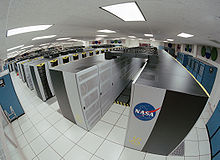
While a computer can, in theory, be made out of almost anything (see misconceptions section), and mechanical examples of computers have existed through much of recorded human history, the first electronic computers were developed in the mid-20th century (1940–1945). Originally, they were the size of a large room, consuming as much power as several hundred modern personal computers (PCs). Modern computers based on integrated circuits are millions to billions of times more capable than the early machines, and occupy a fraction of the space. Simple computers are small enough to fit into mobile devices, and can be powered by a small battery. Personal computers in their various forms are icons of the Information Age and are what most people think of as "computers". However, the embedded computers found in many devices from MP3 players to fighter aircraft and from toys to industrial robots are the most numerous.

History of Computing
The first use of the word "computer" was recorded in 1613, referring to a person who carried out calculations, or computations, and the word continued to be used in that sense until the middle of the 20th century. From the end of the 19th century onwards though, the word began to take on its more familiar meaning, describing a machine that carries out computations.

Limited-function ancient computers
The history of the modern computer begins with two separate technologies—automated calculation and programmability—but no single device can be identified as the earliest computer, partly because of the inconsistent application of that term. Examples of early mechanical calculating devices include the abacus, the slide rule and arguably the astrolabe and the Antikythera mechanism, an ancient astronomical computer built by the Greeks around 80 BC. The Greek mathematician Hero of Alexandria (c. 10–70 AD) built a mechanical theater which performed a play lasting 10 minutes and was operated by a complex system of ropes and drums that might be considered to be a means of deciding which parts of the mechanism performed which actions and when. This is the essence of programmability.
The "castle clock", an astronomical clock invented by Al-Jazari in 1206, is considered to be the earliest programmable analog computer. It displayed the zodiac, the solar and lunar orbits, a crescent moon-shaped pointer travelling across a gateway causing automatic doors to open every hour, and five robotic musicians who played music when struck by levers operated by a camshaft attached to a water wheel. The length of day and night could be re-programmed to compensate for the changing lengths of day and night throughout the year.
The Renaissance saw a re-invigoration of European mathematics and engineering. Wilhelm Schickard's 1623 device was the first of a number of mechanical calculators constructed by European engineers, but none fit the modern definition of a computer, because they could not be programmed.

First general-purpose computers
In 1801, Joseph Marie Jacquard made an improvement to the textile loom by introducing a series of punched paper cards as a template which allowed his loom to weave intricate patterns automatically. The resulting Jacquard loom was an important step in the development of computers because the use of punched cards to define woven patterns can be viewed as an early, albeit limited, form of programmability.
It was the fusion of automatic calculation with programmability that produced the first recognizable computers. In 1837, Charles Babbage was the first to conceptualize and design a fully programmable mechanical computer, his analytical engine. Limited finances and Babbage's inability to resist tinkering with the design meant that the device was never completed.
In the late 1880s, Herman Hollerith invented the recording of data on a machine readable medium. Prior uses of machine readable media, above, had been for control, not data. "After some initial trials with paper tape, he settled on punched cards ..." To process these punched cards he invented the tabulator, and the keypunch machines. These three inventions were the foundation of the modern information processing industry. Large-scale automated data processing of punched cards was performed for the 1890 United States Census by Hollerith's company, which later became the core of IBM. By the end of the 19th century a number of technologies that would later prove useful in the realization of practical computers had begun to appear: the punched card, Boolean algebra, the vacuum tube (thermionic valve) and the teleprinter.
During the first half of the 20th century, many scientific computing needs were met by increasingly sophisticated analog computers, which used a direct mechanical or electrical model of the problem as a basis for computation. However, these were not programmable and generally lacked the versatility and accuracy of modern digital computers.
Alan Turing is widely regarded to be the father of modern computer science. In 1936 Turing provided an influential formalisation of the concept of the algorithm and computation with the Turing machine, providing a blueprint for the electronic digital computer. Of his role in the creation of the modern computer, Time magazine in naming Turing one of the 100 most influential people of the 20th century, states: "The fact remains that everyone who taps at a keyboard, opening a spreadsheet or a word-processing program, is working on an incarnation of a Turing machine".

The Atanasoff–Berry Computer (ABC) was among the first fully electronic digital binary computing devices. Conceived in 1937 by Iowa State College physics professor John Atanasoff, and built with the assistance of graduate student Clifford Berry, the machine was not programmable in the modern sense, being designed only to solve systems of linear equations. The computer did employ parallel computation. A 1973 court ruling in a patent dispute found that the patent for the 1946 ENIAC computer derived from the Atanasoff–Berry Computer.
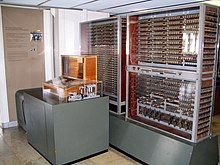
The inventor of the program-controlled computer was Konrad Zuse, who built the first working computer in 1941 and later in 1955 the first computer based on magnetic storage.
George Stibitz is internationally recognized as a father of the modern digital computer. While working at Bell Labs in November 1937, Stibitz invented and built a relay-based calculator he dubbed the "Model K" (for "kitchen table", on which he had assembled it), which was the first to use binary circuits to perform an arithmetic operation. Later models added greater sophistication including complex arithmetic and programmability.
A succession of steadily more powerful and flexible computing devices were constructed in the 1930s and 1940s, gradually adding the key features that are seen in modern computers. The use of digital electronics (largely invented by Claude Shannon in 1937) and more flexible programmability were vitally important steps, but defining one point along this road as "the first digital electronic computer" is difficult.Shannon 1940 Notable achievements include.
Konrad Zuse's electromechanical "Z machines". The Z3 (1941) was the first working machine featuring binary arithmetic, including floating point arithmetic and a measure of programmability. In 1998 the Z3 was proved to be Turing complete, therefore being the world's first operational computer.
The non-programmable Atanasoff–Berry Computer (commenced in 1937, completed in 1941) which used vacuum tube based computation, binary numbers, and regenerative capacitor memory. The use of regenerative memory allowed it to be much more compact than its peers (being approximately the size of a large desk or workbench), since intermediate results could be stored and then fed back into the same set of computation elements.
The secret British Colossus computers (1943), which had limited programmability but demonstrated that a device using thousands of tubes could be reasonably reliable and electronically reprogrammable. It was used for breaking German wartime codes.
The Harvard Mark I (1944), a large-scale electromechanical computer with limited programmability.
The U.S. Army's Ballistic Research Laboratory ENIAC (1946), which used decimal arithmetic and is sometimes called the first general purpose electronic computer (since Konrad Zuse's Z3 of 1941 used electromagnets instead of electronics). Initially, however, ENIAC had an inflexible architecture which essentially required rewiring to change its programming.
Stored-program architecture
Several developers of ENIAC, recognizing its flaws, came up with a far more flexible and elegant design, which came to be known as the "stored program architecture" or von Neumann architecture. This design was first formally described by John von Neumann in the paper First Draft of a Report on the EDVAC, distributed in 1945. A number of projects to develop computers based on the stored-program architecture commenced around this time, the first of these being completed in Great Britain. The first working prototype to be demonstrated was the Manchester Small-Scale Experimental Machine (SSEM or "Baby") in 1948. The Electronic Delay Storage Automatic Calculator (EDSAC), completed a year after the SSEM at Cambridge University, was the first practical, non-experimental implementation of the stored program design and was put to use immediately for research work at the university. Shortly thereafter, the machine originally described by von Neumann's paper—EDVAC—was completed but did not see full-time use for an additional two years.
Nearly all modern computers implement some form of the stored-program architecture, making it the single trait by which the word "computer" is now defined. While the technologies used in computers have changed dramatically since the first electronic, general-purpose computers of the 1940s, most still use the von Neumann architecture.
Beginning in the 1950s, Soviet scientists Sergei Sobolev and Nikolay Brusentsov conducted research on ternary computers, devices that operated on a base three numbering system of −1, 0, and 1 rather than the conventional binary numbering system upon which most computers are based. They designed the Setun, a functional ternary computer, at Moscow State University. The device was put into limited production in the Soviet Union, but supplanted by the more common binary architecture.

Semiconductors and microprocessors
Computers using vacuum tubes as their electronic elements were in use throughout the 1950s, but by the 1960s had been largely replaced by transistor-based machines, which were smaller, faster, cheaper to produce, required less power, and were more reliable. The first transistorised computer was demonstrated at the University of Manchester in 1953. In the 1970s, integrated circuit technology and the subsequent creation of microprocessors, such as the Intel 4004, further decreased size and cost and further increased speed and reliability of computers. By the late 1970s, many products such as video recorders contained dedicated computers called microcontrollers, and they started to appear as a replacement to mechanical controls in domestic appliances such as washing machines. The 1980s witnessed home computers and the now ubiquitous personal computer. With the evolution of the Internet, personal computers are becoming as common as the television and the telephone in the household.
Modern smartphones are fully programmable computers in their own right, and as of 2009 may well be the most common form of such computers in existence.