Pages

Tuesday, February 2, 2010

Ethernet

Ethernet is a family of frame-based computer networking technologies for local area networks (LANs). The name came from the physical concept of the ether. It defines a number of wiring and signaling standards for the Physical Layer of the OSI networking model as well as a common addressing format and Media Access Control at the Data Link Layer.
Ethernet is standardized as IEEE 802.3. The combination of the twisted pair versions of Ethernet for connecting end systems to the network, along with the fiber optic versions for site backbones, is the most widespread wired LAN technology. It has been used from around 1980 to the present, largely replacing competing LAN standards such as token ring, FDDI, and ARCNET.
History
Ethernet was developed at Xerox PARC between 1973 and 1975. It was inspired by ALOHAnet, which Robert Metcalfe had studied as part of his Ph.D. dissertation. In 1975, Xerox filed a patent application listing Metcalfe, David Boggs, Chuck Thacker and Butler Lampson as inventors. In 1976, after the system was deployed at PARC, Metcalfe and Boggs published a seminal paper.
Metcalfe left Xerox in 1979 to promote the use of personal computers and local area networks (LANs), forming 3Com. He convinced Digital Equipment Corporation (DEC), Intel, and Xerox to work together to promote Ethernet as a standard, the so-called "DIX" standard, for "Digital/Intel/Xerox"; it specified the 10 megabits/second Ethernet, with 48-bit destination and source addresses and a global 16-bit Ethertype-type field. The first standard draft was first published on September 30, 1980 by the Institute of Electrical and Electronics Engineers (IEEE).[citation needed] Support of Ethernet's carrier sense multiple access with collision detection (CSMA/CD) in other standardization bodies (i.e., ECMA, IEC, and ISO) was instrumental in getting past delays of the finalization of the Ethernet standard due to the difficult decision processes in the IEEE, and due to the competitive Token Ring proposal strongly supported by IBM.[citation needed] Ethernet initially competed with two largely proprietary systems, Token Ring and Token Bus. These proprietary systems soon found themselves inundated by Ethernet products. In the process, 3Com became a major company. 3Com built the first 10 Mbit/s Ethernet adapter (1981). This was followed quickly by DEC's Unibus to Ethernet adapter, which DEC sold and used internally to build its own corporate network, which reached over 10,000 nodes by 1986; far and away the largest extant computer network in the world at that time.
Through the first half of the 1980s, DEC's Ethernet implementation utilized a coaxial cable about the diameter of a US nickel, which became known as Thick Ethernet when its successor, Thinnet Ethernet was introduced. Thinnet uses a cable similar to cable television cable of the era. The emphasis was on making installation of the cable easier and less costly.
The observation that there was plenty of excess capacity in unused unshielded twisted pair (UTP) telephone wiring already installed in commercial buildings provided another opportunity to expand the installed base, and, thus, twisted-pair Ethernet was the next logical development in the mid-1980s, beginning with StarLAN. UTP-based Ethernet became widely known with 10BASE-T standard. This system replaced the coaxial cable systems with a system of hubs linked via UTP.
In 1990, Kalpana introduced the first Ethernet switch, which replaced the CSMA/CD scheme in favor of a switched full duplex system offering higher performance and at a lower cost than using routers.

Standardization
Notwithstanding its technical merits, timely standardization was instrumental to the success of Ethernet. It required well-coordinated and partly competitive activities in several standardization bodies such as the IEEE, ECMA, IEC, and finally ISO.
In February 1980, IEEE started a project, IEEE 802, for the standardization of local area networks (LAN).
The "DIX-group" with Gary Robinson (DEC), Phil Arst (Intel), and Bob Printis (Xerox) submitted the so-called "Blue Book" CSMA/CD specification as a candidate for the LAN specification. Since IEEE membership is open to all professionals, including students, the group received countless comments on this brand-new technology.
In addition to CSMA/CD, Token Ring (supported by IBM) and Token Bus (selected and henceforward supported by General Motors) were also considered as candidates for a LAN standard. Due to the goal of IEEE 802 to forward only one standard and due to the strong company support for all three designs, the necessary agreement on a LAN standard was significantly delayed.
In the Ethernet camp, it put at risk the market introduction of the Xerox Star workstation and 3Com's Ethernet LAN products. With such business implications in mind, David Liddle (General Manager, Xerox Office Systems) and Metcalfe (3Com) strongly supported a proposal of Fritz Röscheisen (Siemens Private Networks) for an alliance in the emerging office communication market, including Siemens' support for the international standardization of Ethernet (April 10, 1981). Ingrid Fromm, Siemens representative to IEEE 802 quickly achieved broader support for Ethernet beyond IEEE by the establishment of a competing Task Group "Local Networks" within the European standards body ECMA TC24. As early as March 1982 ECMA TC24 with its corporate members reached agreement on a standard for CSMA/CD based on the IEEE 802 draft. The speedy action taken by ECMA decisively contributed to the conciliation of opinions within IEEE and approval of IEEE 802.3 CSMA/CD by the end of 1982.
Approval of Ethernet on the international level was achieved by a similar, cross-partisan action with Fromm as liaison officer working to integrate IEC TC83 and ISO TC97SC6, and the ISO/IEEE 802/3 standard was approved in 1984.

Evolution
Ethernet is an evolving technology. Evolutions have included higher bandwidth, improved media access control methods, and changes to the physical medium. Ethernet evolved into the complex networking technology that today underlies most LANs. The coaxial cable was replaced with point-to-point links connected by Ethernet repeaters or switches to reduce installation costs, increase reliability, and enable point-to-point management and troubleshooting. There are many variants of Ethernet in common use.
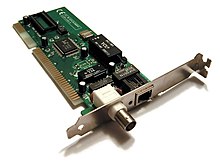
Ethernet stations communicate by sending each other data packets, blocks of data that are individually sent and delivered. As with other IEEE 802 LANs, each Ethernet station is given a 48-bit MAC address. The MAC addresses are used to specify both the destination and the source of each data packet. Network interface cards (NICs) or chips normally do not accept packets addressed to other Ethernet stations. Adapters come programmed with a globally unique address. Despite the significant changes in Ethernet from a thick coaxial cable bus running at 10 Mbit/s to point-to-point links running at 1 Gbit/s and beyond, all generations of Ethernet (excluding early experimental versions) use the same frame formats (and hence the same interface for higher layers), and can be readily interconnected through bridging.
Due to the ubiquity of Ethernet, the ever-decreasing cost of the hardware needed to support it, and the reduced panel space needed by twisted pair Ethernet, most manufacturers now build the functionality of an Ethernet card directly into PC motherboards, eliminating the need for installation of a separate network card.

Friday, January 22, 2010

Infrared

Infrared (IR) light is electromagnetic radiation with a wavelength between 0.7 and 300 micrometres, which equates to a frequency range between approximately 1 and 430 THz.
IR wavelengths are longer than that of visible light, but shorter than that of terahertz radiation microwaves. Bright sunlight provides an irradiance of just over 1 kilowatt per square meter at sea level. Of this energy, 527 watts is infrared radiation, 445 watts is visible light, and 32 watts is ultraviolet radiation.

Overview
Infrared imaging is used extensively for military and civilian purposes. Military applications include target acquisition, surveillance, night vision, homing and tracking. Non-military uses include thermal efficiency analysis, remote temperature sensing, short-ranged wireless communication, spectroscopy, and weather forecasting. Infrared astronomy uses sensor-equipped telescopes to penetrate dusty regions of space, such as molecular clouds; detect objects such as planets, and to view highly red-shifted objects from the early days of the universe.
Humans at normal body temperature radiate chiefly at wavelengths around 12μm (micrometers), as shown by Wien's displacement law.
At the atomic level, infrared energy elicits vibrational modes in a molecule through a change in the dipole moment, making it a useful frequency range for study of these energy states for molecules of the proper symmetry. Infrared spectroscopy examines absorption and transmission of photons in the infrared energy range, based on their frequency and intensity.

Origins of the term
The name means below red, the Latin infra meaning "below". Red is the color of the longest wavelengths of visible light. Infrared light has a longer wavelength (and so a lower frequency) than that of red light visible to humans, hence the literal meaning of below red.

Different regions in the infrared
Objects generally emit infrared radiation across a spectrum of wavelengths, but only a specific region of the spectrum is of interest because sensors are usually designed only to collect radiation within a specific bandwidth. As a result, the infrared band is often subdivided into smaller sections.

CIE division scheme
The International Commission on Illumination (CIE) recommended the division of infrared radiation into the following three bands:

  • IR-A: 700 nm–1400 nm (0.7 µm – 1.4 µm)
  • IR-B: 1400 nm–3000 nm (1.4 µm – 3 µm)
  • IR-C: 3000 nm–1 mm (3 µm – 1000 µm)

A commonly used sub-division scheme is:
Near-infrared (NIR, IR-A DIN): 0.75-1.4 µm in wavelength, defined by the water absorption, and commonly used in fiber optic telecommunication because of low attenuation losses in the SiO2 glass (silica) medium. Image intensifiers are sensitive to this area of the spectrum. Examples include night vision devices such as night vision goggles.
Short-wavelength infrared (SWIR, IR-B DIN): 1.4-3 µm, water absorption increases significantly at 1,450 nm. The 1,530 to 1,560 nm range is the dominant spectral region for long-distance telecommunications.
Mid-wavelength infrared (MWIR, IR-C DIN) also called intermediate infrared (IIR): 3-8 µm. In guided missile technology the 3-5 µm portion of this band is the atmospheric window in which the homing heads of passive IR 'heat seeking' missiles are designed to work, homing on to the IR signature of the target aircraft, typically the jet engine exhaust plume.
Long-wavelength infrared (LWIR, IR-C DIN): 8–15 µm. This is the "thermal imaging" region, in which sensors can obtain a completely passive picture of the outside world based on thermal emissions only and requiring no external light or thermal source such as the sun, moon or infrared illuminator. Forward-looking infrared (FLIR) systems use this area of the spectrum. Sometimes also called the "far infrared."
Far infrared (FIR): 15 - 1,000 µm (see also far infrared laser).
NIR and SWIR is sometimes called "reflected infrared" while MWIR and LWIR is sometimes referred to as "thermal infrared." Due to the nature of the blackbody radiation curves, typical 'hot' objects, such as exhaust pipes, often appear brighter in the MW compared to the same object viewed in the LW.

Thursday, January 14, 2010

General Packet Radio Service

General packet radio service (GPRS) is a packet oriented mobile data service on the 2G and 3G cellular communication systems global system for mobile communications (GSM). The service is available to users in over 200 countries worldwide. GPRS was originally standardized by European Telecommunications Standards Institute (ETSI) in response to the earlier CDPD and i-mode packet switched cellular technologies. It is now maintained by the 3rd Generation Partnership Project (3GPP).
It is a best-effort service, as opposed to circuit switching, where a certain quality of service (QoS) is guaranteed during the connection. In 2G systems, GPRS provides data rates of 56-114 kbit/second. 2G cellular technology combined with GPRS is sometimes described as 2.5G, that is, a technology between the second (2G) and third (3G) generations of mobile telephony. It provides moderate-speed data transfer, by using unused time division multiple access (TDMA) channels in, for example, the GSM system. GPRS is integrated into GSM Release 97 and newer releases.
GPRS usage charging is based on volume of data, either as part of a bundle or on a pay as you use basis. An example of a bundle is up to 5 GB per month for a fixed fee. Usage above the bundle cap is either charged for per megabyte or disallowed. The pay as you use charging is typically per megabyte of traffic. This contrasts with circuit switching data, which is typically billed per minute of connection time, regardless of whether or not the user transfers data during that period.

Services offered
GPRS extends the GSM circuit switched data capabilities and makes the following services possible:

  • "Always on" internet access
  • Multimedia messaging service (MMS)
  • Push to talk over cellular (PoC/PTT)
  • Instant messaging and presence—wireless village
  • Internet applications for smart devices through wireless application protocol (WAP)
  • Point-to-point (P2P) service: inter-networking with the Internet (IP)

If SMS over GPRS is used, an SMS transmission speed of about 30 SMS messages per minute may be achieved. This is much faster than using the ordinary SMS over GSM, whose SMS transmission speed is about 6 to 10 SMS messages per minute.

Protocols supported
GPRS supports the following protocols:

  • internet protocol (IP). In practice, mobile built-in browsers use IPv4 since IPv6 is not yet popular.
  • point-to-point protocol (PPP). In this mode PPP is often not supported by the mobile phone operator but if the mobile is used as a modem to the connected computer, PPP is used to tunnel IP to the phone. This allows an IP address to be assigned dynamically to the mobile equipment.
  • X.25 connections. This is typically used for applications like wireless payment terminals, although it has been removed from the standard. X.25 can still be supported over PPP, or even over IP, but doing this requires either a network based router to perform encapsulation or intelligence built in to the end-device/terminal; e.g., user equipment (UE).

When TCP/IP is used, each phone can have one or more IP addresses allocated. GPRS will store and forward the IP packets to the phone even during handover. The TCP handles any packet loss (e.g. due to a radio noise induced pause).

Hardware
Devices supporting GPRS are divided into three classes:
Class A
Can be connected to GPRS service and GSM service (voice, SMS), using both at the same time. Such devices are known to be available today.
Class B
Can be connected to GPRS service and GSM service (voice, SMS), but using only one or the other at a given time. During GSM service (voice call or SMS), GPRS service is suspended, and then resumed automatically after the GSM service (voice call or SMS) has concluded. Most GPRS mobile devices are Class B.
Class C
Are connected to either GPRS service or GSM service (voice, SMS). Must be switched manually between one or the other service.
A true Class A device may be required to transmit on two different frequencies at the same time, and thus will need two radios. To get around this expensive requirement, a GPRS mobile may implement the dual transfer mode (DTM) feature. A DTM-capable mobile may use simultaneous voice and packet data, with the network coordinating to ensure that it is not required to transmit on two different frequencies at the same time. Such mobiles are considered pseudo-Class A, sometimes referred to as "simple class A". Some networks are expected to support DTM in 2007.

USB 3G/GPRS modems use a terminal-like interface over USB 1.1, 2.0 and later, data formats V.42bis, and RFC 1144 and some models have connector for external antenna. Modems can be added as cards (for laptops) or external USB devices which are similar in shape and size to a computer mouse, or nowadays more like a pendrive.

Addressing
A GPRS connection is established by reference to its access point name (APN). The APN defines the services such as wireless application protocol (WAP) access, short message service (SMS), multimedia messaging service (MMS), and for Internet communication services such as email and World Wide Web access.
In order to set up a GPRS connection for a wireless modem, a user must specify an APN, optionally a user name and password, and very rarely an IP address, all provided by the network operator.

Tuesday, January 12, 2010

WiMAX

WiMAX (Worldwide Interoperability for Microwave Access) is a telecommunications protocol that provides fixed and fully mobile Internet access. The current WiMAX revision provides up to 40 Mbit/s with the IEEE 802.16m update expected to offer up to 1 Gbit/s fixed speeds. The name "WiMAX" was created by the WiMAX Forum, which was formed in June 2001 to promote conformity and interoperability of the standard. The forum describes WiMAX as "a standards-based technology enabling the delivery of last mile wireless broadband access as an alternative to cable and DSL".

Terminology
WiMAX refers to interoperable implementations of the IEEE 802.16 wireless-networks standard (ratified by the WiMAX Forum), in similarity with Wi-Fi, which refers to interoperable implementations of the IEEE 802.11 Wireless LAN standard (ratified by the Wi-Fi Alliance). The WiMAX Forum certification allows vendors to sell their equipment as WiMAX (Fixed or Mobile) certified, thus ensuring a level of interoperability with other certified products, as long as they fit the same profile.
The IEEE 802.16 standard forms the basis of 'WiMAX' and is sometimes referred to colloquially as "WiMAX", "Fixed WiMAX", "Mobile WiMAX", "802.16d" and "802.16e." Clarification of the formal names are as follow:

  • 802.16-2004 is also known as 802.16d, which refers to the working party that has developed that standard. It is sometimes referred to as "Fixed WiMAX," since it has no support for mobility.
  • 802.16e-2005, often abbreviated to 802.16e, is an amendment to 802.16-2004. It introduced support for mobility, among other things and is therefore also known as "Mobile WiMAX".

Mobile WiMAX is the WiMAX incarnation that has the most commercial interest to date and is being actively deployed in many countries. Mobile WiMAX is also the basis of future revisions of WiMAX. As such, references to and comparisons with "WiMAX" in this Wikipedia article mean "Mobile WiMAX".

Uses
The bandwidth and range of WiMAX make it suitable for the following potential applications:

  • Providing portable mobile broadband connectivity across cities and countries through a variety of devices.
  • Providing a wireless alternative to cable and DSL for "last mile" broadband access.
  • Providing data, telecommunications (VoIP) and IPTV services (triple play).
  • Providing a source of Internet connectivity as part of a business continuity plan.


Broadband
Companies are deploying WiMAX to provide mobile broadband or at-home broadband connectivity across whole cities or countries. In many cases this has resulted in competition in markets which typically only had access to broadband through an existing incumbent DSL (or similar) operator.
Additionally, given the relatively low cost to deploy a WiMAX network (in comparison to GSM, DSL or Fiber-Optic), it is now possible to provide broadband in places where it might have been previously economically unviable.

Backhaul
WiMAX is a possible replacement candidate for cellular phone technologies such as GSM and CDMA, or can be used as an overlay to increase capacity. Fixed WiMAX is also considered as a wireless backhaul technology for 2G, 3G, and 4G networks in both developed and developing nations.
In North America, backhaul for urban cellular operations is typically provided via one or more copper wire line T1 connections, whereas remote cellular operations are sometimes backhauled via satellite. In most other regions, urban and rural backhaul is usually provided by microwave links. (The exception to this is where the network is operated by an incumbent with ready access to the copper network, in which case T1 lines may be used.) WiMAX is a broadband platform and as such has much more substantial backhaul bandwidth requirements than legacy cellular applications. Therefore, traditional copper wire line backhaul solutions are not appropriate. Consequently the use of wireless microwave backhaul is on the rise in North America and existing microwave backhaul links in all regions are being upgraded. Capacities of between 34 Mbit/s and 1 Gbit/s are routinely being deployed with latencies in the order of 1 ms. In many cases, operators are aggregating sites using wireless technology and then presenting traffic on to fiber networks where convenient.

Triple-play
WiMAX supports the technologies that make triple-play service offerings possible (such as Quality of Service and Multicasting).
On May 7, 2008 in the United States, Sprint Nextel, Google, Intel, Comcast, Bright House, and Time Warner announced a pooling of an average of 120 MHz of spectrum and merged with Clearwire to form a company which will take the name "Clear". The new company hopes to benefit from combined services offerings and network resources as a springboard past its competitors. The cable companies will provide media services to other partners while gaining access to the wireless network as a Mobile virtual network operator to provide triple-play services.
Some analysts have questioned how the deal will work out: Although fixed-mobile convergence has been a recognized factor in the industry, prior attempts to form partnerships among wireless and cable companies have generally failed to lead to significant benefits to the participants. Other analysts point out that as wireless progresses to higher bandwidth, it inevitably competes more directly with cable and DSL, inspiring competitors into collaboration. Also, as wireless broadband networks grow denser and usage habits shift, the need for increased backhaul and media service will accelerate, therefore the opportunity to leverage cable assets is expected to increase.

Rapid deployment
WiMAX access was used to assist with communications in Aceh, Indonesia, after the tsunami in December 2004. All communication infrastructure in the area, other than amateur radio, was destroyed, making the survivors unable to communicate with people outside the disaster area and vice versa. WiMAX provided broadband access that helped regenerate communication to and from Aceh.
WiMAX hardware was donated by Intel Corporation to assist the Federal Communications Commission (FCC) and FEMA in their communications efforts in the areas affected by Hurricane Katrina. In practice, volunteers used mainly self-healing mesh, Voice over Internet Protocol (VoIP), and a satellite uplink combined with Wi-Fi on the local link.