Pages

Monday, March 8, 2010

Tomb Raider (Game)

Tomb Raider is a media franchise consisting of action-adventure games, comic books, novels, theme park rides, and movies, centring around the adventures of the fictional British archaeologist Lara Croft. Since the release of the original Tomb Raider in 1996, the series developed into a lucrative franchise of related media, and Lara went on to become a major icon of the video game industry. The Guinness Book of World Records has recognised Lara Croft as the "Most Successful Human Videogame Heroine" in 2006. Six games in the series were developed by Core Design, and the latest three by Crystal Dynamics. To date two movies, Lara Croft: Tomb Raider and Lara Croft Tomb Raider: The Cradle of Life, have been produced starring American actress Angelina Jolie as Lara Croft.

Lara Croft
The central character in Tomb Raider is the British archaeologist Lara Croft, a female adventurer in search of ancient treasures. Lara was created by one-time Core designer Toby Gard, and grew out of a number of ideas discarded in early concepts. She appears almost invariably with brown shorts, a green or blue sleeveless top, holsters on both sides of her hip for dual wielded pistols and a small brown backpack. Over the course of the series, her 3D model has undergone gradual graphical improvements, as well as enlarged (and later reduced) breast size.
Over the course of time, the Tomb Raider series canon has undergone various changes or retcons. These changes correspond to the series entering a new medium, such as comic books or film, or being taken over by a new game developer. For example, in the first Tomb Raider game manual, Lara Croft is said to have survived a plane crash in the Himalayas at the age of twenty one, and was later disowned by her parents, who are still living. However in the comics, Lara lost both her parents and her fiancé in the crash. The films make no mention of a plane crash, Lara's mother died when she was too young to remember, and her father died under different circumstances. When development of Tomb Raider was transferred from Core Design to Crystal Dynamics, Lara's biography, only ever mentioned in instruction manuals, was contradicted by a new biography which supported an in game sub-plot concerning the deaths of Lara's parents.

Alison Carroll, the current official Lara Croft model

Several actresses and models have taken on the role of Lara Croft in real life for publicity purposes, including the British model Nell McAndrew, as an official model, and Rhona Mitra, in the early days of the games' success. In addition, playing Lara at game conventions is a popular type of modelling work. Alison Carroll is the current official portrayer of Lara. American actress Angelina Jolie was cast as Lara Croft in the Tomb Raider movies.
Nearly fifteen years after the release of the original game, Lara is still one of the most durable and recognisable video game characters. Alternatively viewed as a feminist icon or sexual fantasy, the impact of her character on popular culture is undeniable.

Video games
The Tomb Raider video games have together sold over 35 million units, making it one of the best-selling video game series of all time.
The original game, titled Tomb Raider, made its début on the Sega Saturn, PlayStation and PC. Despite being released on the Saturn first alongside PC, it was one of the titles responsible for the PlayStation's success in the mid 1990s. The games present a world in 3D: a series of tombs, and other locations, through which the player must guide Lara. On the way, she must kill dangerous creatures or other humans, while collecting objects and solving puzzles to gain access to an ultimate prize, usually a powerful artefact.
Tomb Raider, an early example of the 3D genre, uses third-person shooter mechanics. The player's camera follows her, usually over her shoulder or from behind. Until Tomb Raider: The Angel of Darkness, the game's environments were largely orthogonal, as a result of the creators' decision to extend the 2D platform game genre to a 3D world. This is shown through Tomb Raider's gameplay, which is very reminiscent of older platform games like Prince of Persia and Flashback that had a heavy focus on timed jumping interspersed with combat.
Each game has introduced new weapons and moves; by the fourth game, Lara could back flip off ropes and turn around in mid-air to grab a ledge behind her. Tomb Raider: Legend introduced an electromagnetic grapple that Lara can attach to metal objects and can, amongst other things, be used to make rope swings and pull metal objects (and enemies) toward her. Standard moves in Lara's range of abilities include the somersault, a roll, climbing techniques, the ability to swim, a swan dive manoeuvre, and a handstand. In Tomb Raider III, a sprinting move was introduced that allowed Lara to quickly speed up while a bar in the lower corner of the screen drained her stamina. In Tomb Raider: Chronicles, Lara was able to bar-swing and somersault/roll out of crawl spaces higher than ground level.

The storyline is usually driven by the quest for a powerful artefact, with Lara in a race against a sinister shadow league who want to obtain the relic for their own purposes. These artefacts usually possess mystical powers and may be of supernatural, or even alien, origin. Often in the series, the antagonist uses the artefact or bits of it to create terrifying mystical monsters, creatures, and mutants which Lara must defeat throughout the journey.
On August 18, 2010, Crystal Dynamics and Square Enix released a download-only title, Lara Croft and the Guardian of Light, the first game in the series not to bear the name Tomb Raider. The omission of the Tomb Raider branding was said to separate Lara Croft and the Guardian of Light from the "pillar" Tomb Raider games, which are also still being produced.
In an interview with GamingIndians.com, Ian Livingstone, Life President of Eidos Interactive, announced that the next Tomb Raider was currently in the works. Livingstone stated "I think it will surprise a lot of people and reinvigorate the franchise." The official site revealed the next Tomb Raider game which is simply titled Tomb Raider, It is described as a reboot of Lara Croft. No official release dates have been confirmed.

Saturday, February 27, 2010

Alone in the Dark (Game)

Alone in the Dark is a 1992 survival horror game developed by Infogrames. The game has spawned several sequels, as part of the Alone in the Dark series, and was one of the first survival horror games, after the 1989 Capcom game, Sweet Home. Alone in the Dark set the standard for later rival popular survival horror games such as Resident Evil and Silent Hill.
This game is known to take place in the same continuity as Infogrames's slightly later game Shadow of the Comet, as a book located in the game makes explicit reference to elements of Shadow of the Comet's backstory.

Story
In 1924, Jeremy Hartwood, a noted artist and the owner of the Louisiana mansion Derceto, has committed suicide by hanging himself. His death appears suspicious yet seems to surprise no-one, for Derceto is widely reputed to be haunted by an evil power. The case is quickly dealt with by the police and soon forgotten by the public. The player assumes the role of either Edward Carnby - a private investigator who is sent to find a piano in the loft for an antique dealer - or Emily Hartwood, Jeremy's niece, who is also interested in finding the piano because she believes a secret drawer in it has a note in which Jeremy explains his suicide. The player, either as Carnby or Hartwood, goes to the mansion to investigate. As the player enters the house, the doors mysteriously slam shut behind him or her. Reluctantly, he or she continues up to the attic. In that room, the action begins.
Seconds after the game allows the player to take control of their character, monsters will make their first attack. The player must then progress back down through the house, fighting off various creatures and other hazards in the house, including a whole staff of staggering zombies and various monsters (not all of which can be killed), booby-traps and arcane books, in order to solve the mystery of Derceto and find a way out.
It is eventually explained through documents found throughout the game that the house was built by an occultist pirate named Ezechiel Pregzt, and beneath the house are caverns that were used for dark rituals and other occult doings. The overall goal of these rituals was to increase his fortunes and unnaturally extend his life. Pregzt's original body was incapacitated after he was shot and Derceto was burned down by encamped Union soldiers during the American Civil War. However, Pregzt's spirit lived on within his dried-up corpse, and had been placed by his servants in an old tree in the caverns underneath Derceto (which is, as Pregzt explains in one of many books lying around the house, an alternate name for Astarte or Shub-Niggurath). It would be possible for him to regenerate himself, though that requires a living body. Jeremy Hartwood committed suicide to prevent being used for this purpose; so Pregzt now focuses his energies on the player.

Characters

Edward Carnby
A supernatural private investigator who is sent to a Louisana mansion to find a Piano which Jeremy Hartwood's niece is eager to find as she believe it to hold his suicide note. As soon as Edward enters the house, the doors slam shut but persistent Edward continues his search and battles several paranormal apparitions in the process.
Emily Hartwood
A niece of Derceto's last owner: alternative protagonist to Carnby, she goes on to become an actress and appears in the third game.
Jeremy Hartwood
Last owner of Derceto mansion. Professional artist. Horrified by nightmares, which were in fact Pregzt's attempts to possess him, hanged himself in the loft. Jeremy's father, Howard Hartwood, bought Derceto's ruins in 1875, rebuilt it as it had been before fire, and later unearthed and explored its underground tunnels.
Ezechiel Pregzt
Given name Bloody Ezech. Reportedly the bloodiest pirate in all the Seven Seas. Anchored his ship Astarte near New Orleans, Louisiana. Made a hideout in a swamp, but ultimately was hanged in 1620 by Welsh Naval conscripts. Was reborn as Eliah Pickford. Now, his spirit lives underneath the Derceto Mansion, waiting to live again by possessing a living, human host and unleash darkness upon the world.

Gameplay
Edward Carnby as seen in the game.
Players are given the option of choosing between a male or female protagonist (Edward Carnby or Emily Hartwood respectively), and are then trapped inside the haunted mansion of Derceto after dark. The player character starts in the attic (the place of Jeremy's suicide by hanging), having ascended to the top of the mansion without incident, and is then tasked with exploring the mansion in order to find a way out while avoiding, outsmarting or defeating various supernatural enemies including slave zombies, giant bipedal rat-like creatures, and other even more bizarre foes. Though starting with no weapons except fists and feet, the player character can find, and utilise, weapons such as firearms, kitchen knives, and swords.
However, combat only plays a partial role in the gameplay. For example, the total number of slave zombies throughout the entire game is only about a dozen, and many opponents can be beaten by solving a particular puzzle rather than a straight fight - indeed, a significant number of opponents cannot be killed. Much of the game involves exploration and puzzle-solving, and searching the house for clues to advance the story and learn more about what happened before the player's arrival.
The story is revealed to the player through an extensive series of books and notes found throughout the game, and is heavily influenced by the works of H. P. Lovecraft. Grimoires found in the mansion's library include the Necronomicon and De Vermis Mysteriis, both taken from Lovecraft's Cthulhu Mythos. Other Mythos references include books that feature the narrated history of Lord Boleskine, a direct reference to another Infogrames Cthulhu Mythos-based game, Shadow of the Comet, and the last name of player character Edward Carnby, a reference to John Carnby, a character in the mythos tale Return of the Sorcerer by Clark Ashton Smith. Several of the supernatural opponents are recognisable creatures from the Mythos, including Deep Ones, Nightgaunts and a Chthonian.

Friday, February 12, 2010

Wireless Network

Wireless network refers to any type of computer network that is wireless, and is commonly associated with a telecommunications network whose interconnections between nodes are implemented without the use of wires. Wireless telecommunications networks are generally implemented with some type of remote information transmission system that uses electromagnetic waves, such as radio waves, for the carrier and this implementation usually takes place at the physical level or "layer" of the network.

Types of wireless connections

Wireless PAN
Wireless Personal Area Networks (WPANs) interconnect devices within a relatively small area, generally within reach of a person. For example, Bluetooth provides a WPAN for interconnecting a headset to a laptop. ZigBee also supports WPAN applications. Wi-Fi PANs are also getting popular as vendors have started integrating Wi-Fi in variety of consumer electronic devices. Intel My WiFi and Windows 7 virtual Wi-Fi capabilities have made Wi-Fi PANs simpler and easier to set up and configure.

Wireless LAN
A wireless local area network (WLAN) links two or more devices using a wireless distribution method (typically spread-spectrum or OFDM radio), and usually providing a connection through an access point to the wider internet. This gives users the mobility to move around within a local coverage area and still be connected to the network.

  • Wi-Fi: Wi-Fi is increasingly used as a synonym for 802.11 WLANs, although it is technically a certification of interoperability between 802.11 devices.
  • Fixed Wireless Data: This implements point to point links between computers or networks at two locations, often using dedicated microwave or laser beams over line of sight paths. It is often used in cities to connect networks in two or more buildings without physically wiring the buildings together.


Wireless MAN
Wireless Metropolitan area networks are a type of wireless network that connects several Wireless LANs.
WiMAX is the term used to refer to wireless MANs and is covered in IEEE 802.16d/802.16e.

Wireless WAN
wireless wide area networks are wireless networks that typically cover large outdoor areas. These networks can be used to connect branch offices of business or as a public internet access system. They are usually deployed on the 2.4 GHz band. A typical system contains base station gateways, access points and wireless bridging relays. Other configurations are mesh systems where each access point acts as a relay also. When combined with renewable energy systems such as photo-voltaic solar panels or wind systems they can be stand alone systems.

Mobile devices networks
With the development of smart phones, cellular telephone networks routinely carry data in addition to telephone conversations:
Global System for Mobile Communications (GSM): The GSM network is divided into three major systems: the switching system, the base station system, and the operation and support system. The cell phone connects to the base system station which then connects to the operation and support station; it then connects to the switching station where the call is transferred to where it needs to go. GSM is the most common standard and is used for a majority of cell phones.
Personal Communications Service (PCS): PCS is a radio band that can be used by mobile phones in North America and South Asia. Sprint happened to be the first service to set up a PCS.
D-AMPS: Digital Advanced Mobile Phone Service, an upgraded version of AMPS, is being phased out due to advancement in technology. The newer GSM networks are replacing the older system.

Uses
Wireless networks have continued to develop and their uses have grown significantly. Cellular phones are part of huge wireless network systems. People use these phones daily to communicate with one another. Sending information overseas is possible through wireless network systems using satellites and other signals to communicate across the world. Emergency services such as the police department utilize wireless networks to communicate important information quickly. People and businesses use wireless networks to send and share data quickly whether it be in a small office building or across the world.
Another important use for wireless networks is as an inexpensive and rapid way to be connected to the Internet in countries and regions where the telecom infrastructure is poor or there is a lack of resources, as in most developing countries.
Compatibility issues also arise when dealing with wireless networks. Different components not made by the same company may not work together, or might require extra work to fix these issues. Wireless networks are typically slower than those that are directly connected through an Ethernet cable.
A wireless network is more vulnerable, because anyone can try to break into a network broadcasting a signal. Many networks offer WEP - Wired Equivalent Privacy - security systems which have been found to be vulnerable to intrusion. Though WEP does block some intruders, the security problems have caused some businesses to stick with wired networks until security can be improved. Another type of security for wireless networks is WPA - Wi-Fi Protected Access. WPA provides more security to wireless networks than a WEP security set up. The use of firewalls will help with security breaches which can help to fix security problems in some wireless networks that are more vulnerable.

Tuesday, February 9, 2010

Wireless Access Point

In computer networking, a wireless access point (WAP) is a device that allows wireless devices to connect to a wired network using Wi-Fi, Bluetooth or related standards. The WAP usually connects to a router (via a wired network), and can relay data between the wireless devices (such as computers or printers) and wired devices on the network.
Industrial grade WAPs are rugged, with a metal cover and a DIN rail mount. During operations they can tolerate a wider temperature range, high humidity and exposure to water, dust, and oil. Wireless security includes: WPA-PSK, WPA2, IEEE 802.1x/RADIUS, WDS, WEP, TKIP, and CCMP (AES) encryption. Unlike home consumer models, industrial wireless access points can also be used as a bridge, router, or a client.

Introduction
Linksys WAP54G 802.11g Wireless Access Point
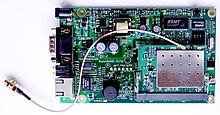
embedded RouterBoard 112 with U.FL-RSMA pigtail and R52 mini PCI Wi-Fi card widely used by wireless Internet service providers (WISPs) across the world
Prior to wireless networks, setting up a computer network in a business, home, or school often required running many cables through walls and ceilings in order to deliver network access to all of the network-enabled devices in the building. With the advent of the Wireless Access Point, network users are now able to add devices that access the network with few or no cables. Today's WAPs are built to support a standard for sending and receiving data using radio frequencies rather than cabling. Those standards, and the frequencies they use are defined by the IEEE. Most WAPs use IEEE 802.11 standards.

Common WAP Applications
A typical corporate use involves attaching several WAPs to a wired network and then providing wireless access to the office LAN. The wireless access points are managed by a WLAN Controller which handles automatic adjustments to RF power, channels, authentication, and security. Further, controllers can be combined to form a wireless mobility group to allow inter-controller roaming. The controllers can be part of a mobility domain to allow clients access throughout large or regional office locations. This saves the clients time and administrators overhead because it can automatically re-associate or re-authenticate.
A Hot Spot is a common public application of WAPs, where wireless clients can connect to the Internet without regard for the particular networks to which they have attached for the moment. The concept has become common in large cities, where a combination of coffeehouses, libraries, as well as privately owned open access points, allow clients to stay more or less continuously connected to the Internet, while moving around. A collection of connected Hot Spots can be referred to as a lily-pad network.
The majority of WAPs are used in Home wireless networks. Home networks generally have only one WAP to connect all the computers in a home. Most are wireless routers, meaning converged devices that include the WAP, a router, and, often, an ethernet switch. Many also include a broadband modem. In places where most homes have their own WAP within range of the neighbors' WAP, it's possible for technically savvy people to turn off their encryption and set up a wireless community network, creating an intra-city communication network without the need of wired networks.
A WAP may also act as the network's arbitrator, negotiating when each nearby client device can transmit. However, the vast majority of currently installed IEEE 802.11 networks do not implement this, using a distributed pseudo-random algorithm called CSMA/CA instead.

Wireless Access Point vs. Ad Hoc Network
Some people confuse Wireless Access Points with Wireless Ad Hoc networks. An Ad Hoc network uses a connection between two or more devices without using a wireless access point: the devices communicate directly when in range. An Ad Hoc network is used in situations such as a quick data exchange or a multiplayer LAN game because setup is easy and does not require an access point. Due to its peer-to-peer layout, Ad Hoc connections are similar to Bluetooth ones and are generally not recommended for a permanent installation.
Internet access via Ad Hoc networks, using features like Windows' Internet Connection Sharing, may work well with a small number of devices that are close to each other, but Ad Hoc networks don't scale well. Internet traffic will converge to the nodes with direct internet connection, potentially congesting these nodes. For internet-enabled nodes, Access Points have a clear advantage, with the possibility of having multiple access points connected by a wired LAN.

Limitations
One IEEE 802.11 WAP can typically communicate with 30 client systems located within a radius of 100 m. However, the actual range of communication can vary significantly, depending on such variables as indoor or outdoor placement, height above ground, nearby obstructions, other electronic devices that might actively interfere with the signal by broadcasting on the same frequency, type of antenna, the current weather, operating radio frequency, and the power output of devices. Network designers can extend the range of WAPs through the use of repeaters and reflectors, which can bounce or amplify radio signals that ordinarily would go un-received. In experimental conditions, wireless networking has operated over distances of several kilometers.
Most jurisdictions have only a limited number of frequencies legally available for use by wireless networks. Usually, adjacent WAPs will use different frequencies (Channels) to communicate with their clients in order to avoid interference between the two nearby systems. Wireless devices can "listen" for data traffic on other frequencies, and can rapidly switch from one frequency to another to achieve better reception. However, the limited number of frequencies becomes problematic in crowded downtown areas with tall buildings using multiple WAPs. In such an environment, signal overlap becomes an issue causing interference, which results in signal droppage and data errors.
Wireless networking lags behind wired networking in terms of increasing bandwidth and throughput. While (as of 2010) typical wireless devices for the consumer market can reach speeds of 300 Mbit/s (megabits per second) (IEEE 802.11n) or 54 Mbit/s (IEEE 802.11g), wired hardware of similar cost reaches 1000 Mbit/s (Gigabit Ethernet). One impediment to increasing the speed of wireless communications comes from Wi-Fi's use of a shared communications medium, so a WAP is only able to use somewhat less than half the actual over-the-air rate for data throughput. Thus a typical 54 MBit/s wireless connection actually carries TCP/IP data at 20 to 25 Mbit/s. Users of legacy wired networks expect faster speeds, and people using wireless connections keenly want to see the wireless networks catch up.
By 2008 draft 802.11n based access points and client devices have already taken a fair share of the market place but with inherent problems integrating products from different vendors.

Security
Wireless access has special security considerations. Many wired networks base the security on physical access control, trusting all the users on the local network, but if wireless access points are connected to the network, anyone on the street or in the neighboring office could connect.
The most common solution is wireless traffic encryption. Modern access points come with built-in encryption. The first generation encryption scheme WEP proved easy to crack; the second and third generation schemes, WPA and WPA2, are considered secure if a strong enough password or passphrase is used.
Some WAPs support hotspot style authentication using RADIUS and other authentication servers.