Pages

Friday, October 15, 2010

Grand Theft Auto History (Game)

History
The Grand Theft Auto series may be divided into canons, based on the inclusion of a numbering after the recognizable title name (e.g. Grand Theft Auto III) after the original Grand Theft Auto's release, and to a certain extent, the type of graphics engine used.

Grand Theft Auto
Grand Theft Auto, the first game in the Grand Theft Auto series, was created by video game developer DMA Design, and was released for Microsoft DOS/Windows in 1997/1998 and also for the PlayStation. The game is set in three different fictional cities, Liberty City, San Andreas and Vice City. A reduced Game Boy Color port was later released.
Subsequently, two expansion packs, Grand Theft Auto: London, 1969 and Grand Theft Auto: London, 1961, were released on 31 March and 1 June 1999, respectively.

Grand Theft Auto 2
The second game in the series, Grand Theft Auto 2, was developed for Microsoft Windows, PlayStation, and Dreamcast and released in the year 1999. Set in the indeterminable future, it featured updated graphics and somewhat different gameplay based upon the player's appeal to various criminal organizations. Grand Theft Auto 2 takes place in a retrofuturistic setting, in an unnamed American city.
A reduced Game Boy Color port was also produced. It is the only Grand Theft Auto game to have a "T" rating for a PlayStation console, it is also the only sequel to have a digit in the title instead of a Roman numeral.

Grand Theft Auto III
Grand Theft Auto III was released in October 2001, and served as the breakthrough for the franchise. The game's setting takes place around that time, in fictional Liberty City, which is loosely based on New York City, but also incorporates elements of other American cities. Grand Theft Auto III brought a third-person view to the series, rather than the traditional top-down view of earlier titles (although the view is still made available as an optional camera angle). For the first time, the problem of navigating in the huge sandbox game was solved by implementing a constant GPS triggered mini-map that highlights the player's position as well as those of current targets. Graphics were also updated with a new 3D game engine. The gameplay engine expanded the explorable world of GTA III, using a mission-based approach. Multiplayer was discarded (third party mods were later released, allowing for multiplayer gameplay), but GTA III improved in many other areas such as voice-acting and plot (in previous games, there was speech only in short animated cut scenes between levels, while other communication was simply subtitles running on the bottom of the screen).
After the success of Grand Theft Auto III, Grand Theft Auto: Vice City was released in 2002. This game was set in 1986 in Vice City, which was based on Miami, Florida. The game's plot focuses on the cocaine trade during the 1980s. Vice City was the first game to introduce fully functional flying vehicles that could be used by the player, such as seaplanes and helicopters. It also featured a variety of new weapons and vehicles.
Grand Theft Auto: San Andreas, released in October 2004, is set in 1992, focusing on California gang life and the awakening of the drug epidemic brought on by crack cocaine. The setting was in the fictional state of San Andreas, which was based on some California and Nevada cities, specifically Los Angeles, San Francisco, and Las Vegas. Their counterparts are Los Santos, San Fierro, and Las Venturas respectively. The game also included a countryside in between Los Santos and San Fierro and also between Los Santos and Las Venturas, and a desert in between Las Venturas and San Fierro.
Grand Theft Auto (unofficially referred to as Grand Theft Auto Advance), for the Game Boy Advance, was also released in 2004. Originally developed as a top-down conversion of GTA III, it eventually became an original game. Unlike the Game Boy Color ports of Grand Theft Auto and Grand Theft Auto 2, Grand Theft Auto did not tone down the violence and profanity common to the GTA series. The game received an "M" rating from the ESRB. It was developed by an external developer, Digital Eclipse.
In 2005 and 2006, Rockstar released two games for the PlayStation Portable, both developed by Rockstar Leeds. Grand Theft Auto: Liberty City Stories is a prequel to Grand Theft Auto III and set in Liberty City in 1998. A PlayStation 2 port was released by Rockstar on 6 June 2006.
Grand Theft Auto: Vice City Stories was released for the PlayStation Portable on 31 October 2006 and set in Vice City in 1984, two years before the events of Grand Theft Auto: Vice City. A PlayStation 2 port of the game was released on 6 March 2007. It is the last game of the third generation series, and the final game in the Grand Theft Auto III canon.
In in-game chronological order the third generation Grand Theft Auto games are:
Grand Theft Auto: Vice City Stories; set in 1984, released in 2006
Grand Theft Auto: Vice City; set in 1986, released in 2002
Grand Theft Auto: San Andreas; set in 1992, released in 2004
Grand Theft Auto: Liberty City Stories; set in 1998, released in 2005
Grand Theft Auto (Game Boy Advance); set in 2000, released in 2004
Grand Theft Auto III; set and released in 2001

Grand Theft Auto IV
Grand Theft Auto IV was released on 29 April 2008, after a six month delay. It was the first Grand Theft Auto game to be released simultaneously for both Sony and Microsoft's video game consoles. In August 2008, Rockstar announced that it was going to publish GTA IV for PC. GTA IV's game engine is the Rockstar Advanced Game Engine (RAGE) used in Rockstar Games Presents Table Tennis and the Euphoria physics engine.

Grand Theft Auto IV has much more realistic gameplay than its predecessors, no characters from previous games appear in GTA IV; according to Dan Houser "virtually none of the characters from the previous games returned, as a lot of them are dead anyway." The game once again takes place in a redesigned Liberty City that very closely resembles New York City, much more than previous renditions.
Microsoft officially announced a "strategic alliance" with Rockstar Games over the rights to episodic content through their Xbox Live service at their X06 event. This content was released as Grand Theft Auto: The Lost and Damned on 17 February 2009, and it was available for download, exclusively for the Xbox 360, this was because of the substantial $50 million that Microsoft paid Rockstar to keep it exclusive. The strategic alliance was however timed and both DLC episodes and the compilation pack were released on 13 April 2010 on PS3 and PC. The expansion adds some new elements to the existing game and focuses on Johnny Klebitz, the vice president of "The Lost" motorcycle gang.
The second and last Grand Theft Auto IV downloadable content episode was called Grand Theft Auto: The Ballad of Gay Tony and was released on 29 October 2009. Grand Theft Auto: Episodes from Liberty City is a compilation pack released for the Xbox 360 at the same time as The Ballad of Gay Tony. It contains The Lost and Damned and The Ballad of Gay Tony on one disk and does not require an original copy of GTA IV.
Grand Theft Auto IV officially introduced online multiplayer to the series. In most games, a customizable character is used to play, and money earned in game is translated to levels, with more customization available at higher levels. The game does not offer split screen or local area network (LAN) multiplayer modes on PlayStation 3 or Xbox 360, but there is LAN on the PC mode. Up to 16 (32 on PC) players can play together, doing a variety of games including Death Match, Cops 'n' Crooks, races, Deal Breaker, and Mafiya Work as well as team varieties of Death Match, and Mafiya Work to name just a few.
Grand Theft Auto: Chinatown Wars is the first Grand Theft Auto game to be released on the Nintendo DS, and was announced at the E3 Nintendo Press Conference on 15 July 2008. This game has several new features, such as touch screen mini-games. The game was released on 17 March 2009 in North America and 20 March 2009 to Australia and Europe. The game is rated 18+ by PEGI and the BBFC (Europe, UK) and M by the ESRB (North America). A PSP version was later announced on 22 June 2009 and was released in North America on 20 October 2009. It was also released on the Apple iOS platform 18 January 2010.
In chronological order the fourth generation Grand Theft Auto games are in order:
Grand Theft Auto IV; set and released in 2008
Grand Theft Auto: The Lost and Damned; set in 2008, released in 2009 for Xbox 360, in 2010 for PlayStation 3 and PC
Grand Theft Auto: The Ballad of Gay Tony; set in 2008, released in 2009 for Xbox 360, in 2010 for PlayStation 3 and PC
Grand Theft Auto: Chinatown Wars; set and released in 2009
On 26 February 2011, five websites were discovered which seemed to indicate the next installment of the Grand Theft Auto franchise.

Thursday, October 14, 2010

Grand Theft Auto (Game)

Grand Theft Auto (commonly abbreviated GTA) is an award-winning video game series created in the United Kingdom by Dave Jones, then later by brothers Dan Houser and Sam Houser, and game designer Zachary Clarke. It is primarily developed by Rockstar North (formerly DMA Design) and published by Rockstar Games. The name of the series is derived from grand theft auto, a term referring to motor vehicle theft.
The series is set in fictional locales heavily modelled on American cities, while an expansion for the original was based in London. Gameplay focuses on an open world where the player can choose missions to progress an overall story, as well as engaging in side activities; all consisting of action, adventure, driving, occasional role-playing, stealth, and racing elements. The subject of the games is usually a comedic satire of American culture, but the series has gained controversy for its adult nature and violent themes. The series focuses around many different protagonists who attempt to rise through the ranks of the criminal underworld, although their motives for doing so vary in each game. The antagonists are commonly characters who have betrayed the protagonist or his organization, or characters who have the most impact impeding the protagonist's progress.
Video game developer DMA Design began the series in 1997, and it currently has ten stand-alone games and four expansion packs. The third chronological title, Grand Theft Auto III, was widely acclaimed, as it brought the series to a 3D setting and more immersive experience, and is considered a landmark title that has subsequently influenced many other open world action games and led to the label "Grand Theft Auto clone" on similar games. Subsequent titles would follow and build upon the concept established in Grand Theft Auto III. Film veterans such as Michael Madsen, Ray Liotta, Burt Reynolds, Dennis Hopper, Danny Trejo, Gary Busey, Samuel L. Jackson, Chris Penn, James Woods, Joe Pantoliano, Frank Vincent, Robert Loggia, Kyle MacLachlan, and Peter Fonda have all voiced major characters in many installments, and the series is critically acclaimed and commercially successful.

Overview
Each game in this series allows players to take on the role of a criminal or a wannabe in a big city, typically an individual who rises through the ranks of organized crime through the course of the game. The player is given various missions by kingpins and major idols in the city underworld which must be completed to progress through the storyline. Assassinations and other crimes feature regularly, but occasionally taxi driving, firefighting, street racing, bus driving, or learning to fly helicopters and fixed-wing aircraft are also involved.
In later titles, notably those released after Grand Theft Auto 2, the player is given a more developed storyline in which he is forced to overcome an unfortunate event (e.g., being betrayed and left for dead), which serves as motivation for the character to advance up the criminal ladder and ultimately leads to the triumph of the character by the end of the storyline. The Grand Theft Auto series belongs to a genre of free-roaming video games called sandbox games, and grants a large amount of freedom to the player in deciding what to do and how to do it through multiple methods of transport and weapons. Most traditional action games are structured as a single track series of levels with linear gameplay, but in GTA the player can determine the missions that he wants to undertake, and his relationships with various characters are changed based on these choices. The cities of the games can also be roamed freely at any point in the game, and are examples of open world video game environments which offer accessible buildings with minor missions in addition to the main storyline. There are exceptions: missions follow a linear, overarching plot, and some city areas must be unlocked over the course of the game.
Grand Theft Auto III and later subsequent games have more prevalent voice acting, and radio stations, which simulate driving to music with disc jockeys, radio personalities, commercials, talk radio, pop music, and American culture.
The use of vehicles in an explorable urban environment provides a basic simulation of a working city, complete with pedestrians who generally obey traffic signals. Further details are used to flesh out an open-ended atmosphere that has been used in several other games, such as The Simpsons Hit & Run, which has less emphasis on crime or violence.

Setting
The Grand Theft Auto series is set in a fictional version of the United States, in a number of different time periods. The original Grand Theft Auto introduced three main locations: Liberty City, based upon New York City, Vice City, based upon Miami, and San Andreas, based upon the Southwestern cities of Los Angeles, San Francisco and Las Vegas.
Subsequent games in the series have reimagined and expanded upon the original locales. Grand Theft Auto III is set in a different rendition of Liberty City only loosely based on New York City. A revised Vice City is depicted in Grand Theft Auto: Vice City. In Grand Theft Auto: San Andreas, the location of San Andreas takes the form of an entire state, instead of a single city. The state of San Andreas is based on the states of California and Nevada, and consists of three major cities: Los Santos (Los Angeles), San Fierro (San Francisco) and Las Venturas (Las Vegas). Surrounding towns and areas of desert, water, woodland and countryside lie between the three cities.
Grand Theft Auto: Liberty City Stories and Grand Theft Auto: Vice City Stories, originally released on the PlayStation Portable handheld console, are set in the previous depictions of their respective eponymous cities.
Grand Theft Auto IV and its subsequent expansion packs The Lost and Damned and The Ballad of Gay Tony are set in a third revision of Liberty City, set in 2008. A version of New Jersey, known as Alderney, is depicted adjacent to the city. Grand Theft Auto: Chinatown Wars is also set in this version of Liberty City, although the state of Alderney is not present.
Other places in the same fictional universe as the Grand Theft Auto series also exist. Carcer City and Cottonmouth are two different cities featured in the Manhunt series. There is also the town of Bullworth from another Rockstar Game's release, Bully.
Only the expansion packs for the original Grand Theft Auto, London 1969 and London 1961, set in London, have featured a location outside of the United States.

Thursday, October 7, 2010

Pixel Art

Pixel art is a form of digital art, created through the use of raster graphics software, where images are edited on the pixel level. Graphics in most old (or relatively limited) computer and video games, graphing calculator games, and many mobile phone games are mostly pixel art.

History
The term pixel art was first published by Adele Goldberg and Robert Flegal of Xerox Palo Alto Research Center in 1982. The concept, however, goes back about 10 years before that, for example in Richard Shoup's SuperPaint system in 1972, also at Xerox PARC.
Some traditional art forms, such as counted-thread embroidery (including cross-stitch) and some kinds of mosaic and beadwork, are very similar to pixel art. These art forms construct pictures out of small colored units similar to the pixels of modern digital computing. A similar concept on a much bigger scale can be seen in the North Korean Arirang Festival.

Definition
Image filters (such as blurring or alpha-blending) or tools with automatic anti-aliasing are considered not valid tools for pixel art, as such tools calculate new pixel values automatically, contrasting with the precise manual arrangement of pixels associated with pixel art.

Techniques
Drawings usually start with what is called the line art, which is the basic line that defines the character, building or anything else the artist is intending to draw. Linearts are usually traced over scanned drawings and are often shared among other pixel artists. Other techniques, some resembling painting, also exist.
The limited palette often implemented in pixel art usually promotes dithering to achieve different shades and colors, but due to the nature of this form of art this is done completely by hand. Hand-made anti-aliasing is also used.

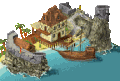
Here are a few parts of the above image of “The Gunk” in detail, depicting a few of the techniques involved:
1. The basic form of dithering, using two colors in a 2×2 checkerboard pattern. Changing the density of each color will lead to different subtones.
2. Stylized dithering with 2×2 pixel squares randomly scattered can produce interesting textures. Small circles are also frequent.
3. Anti-aliasing can be done, by hand, to smooth curves and transitions. Some artists only do this internally, to keep crisp outlines that can go over any background. The PNG alpha channel can be used to create external anti-aliasing for any background.

Saving and Compression
Pixel art is preferably stored in a file format utilizing lossless data compression, such as run-length encoding or an indexed color palette. GIF and PNG are two file formats commonly used for storing pixel art. The JPEG format is avoided because its lossy compression algorithm is designed for smooth continuous-tone images and introduces visible artifacts in the presence of dithering.

Categories
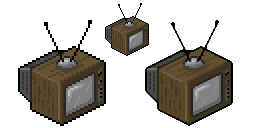
Pixel art is commonly divided in two subcategories: isometric and non-isometric. The isometric kind is drawn in a near-isometric dimetric projection. This is commonly seen in games to provide a three-dimensional view without using any real three-dimensional processing. Technically, an isometric angle would be of 30 degrees from the horizontal, but this is avoided since the pixels created by a line drawing algorithm would not follow a neat pattern. To fix this, lines with a 1:2 pixel ratio are picked, leading to an angle of about 26.6 degrees (arctan 0.5).
Non-isometric pixel art is any pixel art that does not fall in the isometric category, such as views from the top, side, front, bottom or perspective views. These are also called Planometric views.

Scaling
When pixel art is displayed at a higher resolution than the source image, it is often scaled using the nearest neighbor interpolation algorithm. This avoids blurring caused by other algorithms, such as bilinear and bicubic interpolation—which interpolate between adjacent pixels and work best on continuous tones, but not sharp edges or lines. Nearest-neighbor interpolation preserves these sharp edges, but it makes diagonal lines and curves look blocky, an effect called pixelation. Thus, hybrid algorithms have been devised to interpolate between continuous tones while preserving the sharpness of lines in the piece; such attempts include the 2xSaI and Super Eagle algorithms.

Uses
Pixel art was very often used in older computer and video console games. With the increasing use of 3D graphics in games, pixel art lost some of its use. Despite that, this is still a very active professional/amateur area, since mobile phones and other portable devices still have low resolution and then require a skillful use of space and memory. Sometimes pixel art is used for advertising too. One such company that uses pixel art to advertise is Bell. The group eboy specializes in pixel graphics for advertising and has been featured in magazines such as Wired, Popular Science, and Fortune 500.
Icons for operating systems with limited graphics abilities are also pixel art. The limited number of colors and resolution presents a challenge when attempting to convey complicated concepts and ideas in an efficient way. On the Microsoft Windows desktop icons are raster images of various sizes, the smaller of which are not necessarily scaled from the larger ones and could be considered pixel art. On the GNOME and KDE desktops, icons are represented primarily by SVG images, but with hand-optimized, pixel art PNGs for smaller sizes such as 16x16 and 24x24. Another use of pixel art on modern desktop computers is favicons.
Modern pixel art has been seen as a reaction to the 3D graphics industry by amateur game/graphic hobbyists. Many retro enthusiasts often choose to mimic the style of the past. Some view the pixel art revival as restoring the golden age of second and third generation consoles, where it is argued graphics were more aesthetically pleasing. Pixel art still remains popular and has been used in the virtual worlds Citypixel and Habbo as well as among hand-held devices such as the Nintendo DS and Cellphones.

Friday, October 1, 2010

Digital Art

Digital art is a general term for a range of artistic works and practices that use digital technology as an essential part of the creative and/or presentation process. Since the 1970s, various names have been used to describe the process including computer art and multimedia art, and digital art is itself placed under the larger umbrella term new media art.
The impact of digital technology has transformed activities such as painting, drawing and sculpture, while new forms, such as net art, digital installation art, and virtual reality, have become recognized artistic practices. More generally the term digital artist is used to describe an artist who makes use of digital technologies in the production of art. In an expanded sense, "digital art" is a term applied to contemporary art that uses the methods of mass production or digital media.

Digital Production Techniques in Visual Media
The techniques of digital art are used extensively by the mainstream media in advertisements, and by film-makers to produce special effects. Desktop publishing has had a huge impact on the publishing world, although that is more related to graphic design. It is possible that general acceptance of the value of digital art will progress in much the same way as the increased acceptance of electronically produced music over the last three decades.
Digital art can be purely computer-generated (such as fractals and algorithmic art) or taken from other sources, such as a scanned photograph or an image drawn using vector graphics software using a mouse or graphics tablet. Though technically the term may be applied to art done using other media or processes and merely scanned in, it is usually reserved for art that has been non-trivially modified by a computing process (such as a computer program, microcontroller or any electronic system capable of interpreting an input to create an output); digitized text data and raw audio and video recordings are not usually considered digital art in themselves, but can be part of the larger project of computer art and information art. Artworks are considered digital painting when created in similar fashion to non-digital paintings but using software on a computer platform and digitally outputting the resulting image as painted on canvas.
Andy Warhol created digital art with the help of Amiga, Inc. in July 1985 when he publicly introduced at Lincoln Center Amiga paint software.

Digital Photography and Image Processing
Digital photography and digital printing is now an acceptable medium of creation and presentation by major museums and galleries. But the work of artists who produce digital paintings and digital printmakers is beginning to find acceptance, as the output capabilities advance and quality increases. Internationally, many museums are now beginning to collect digital art such as the San Jose Museum of Art and the Victoria and Albert Museum print department also has a reasonable but small collection of digital art. One reason why the established art community finds it difficult to accept digital art is the erroneous perception of digital prints being endlessly reproducible. Many artists though are erasing the relevant image file after the first print, thus making it a unique artwork.
The availability and popularity of photograph manipulation software has spawned a vast and creative library of highly modified images, many bearing little or no hint of the original image. Using electronic versions of brushes, filters and enlargers, these "neographers" produce images unattainable through conventional photographic tools. In addition, digital artists may manipulate scanned drawings, paintings, collages or lithographs, as well as using any of the above-mentioned techniques in combination. Artists also use many other sources of electronic information and programs to create their work.

Computer-Generated Visual Media
There are two main paradigms in computer generated imagery. The simplest is 2D computer graphics which reflect how you might draw using a pencil and a piece of paper. In this case, however, the image is on the computer screen and the instrument you draw with might be a tablet stylus or a mouse. What is generated on your screen might appear to be drawn with a pencil, pen or paintbrush. The second kind is 3D computer graphics, where the screen becomes a window into a virtual environment, where you arrange objects to be "photographed" by the computer. Typically a 2D computer graphics use raster graphics as their primary means of source data representations, whereas 3D computer graphics use vector graphics in the creation of immersive virtual reality installations. A possible third paradigm is to generate art in 2D or 3D entirely through the execution of algorithms coded into computer programs and could be considered the native art form of the computer. That is, it cannot be produced without the computer. Fractal art, Datamoshing, algorithmic art and Dynamic Painting are examples.

Computer Generated 3D Still Imagery
3D graphics are created via the process of designing complex imagery from geometric shapes, polygons or NURBS curves to create three-dimensional shapes, objects and scenes for use in various media such as film, television, print, rapid prototyping and the special visual effects. There are many software programs for doing this. The technology can enable collaboration, lending itself to sharing and augmenting by a creative effort similar to the open source movement, and the creative commons in which users can collaborate in a project to create unique pieces of art.

Computer Generated Animated Imagery
Computer-generated animations are animations created with a computer, from digital models created by the artist. The term is usually applied to works created entirely with a computer. Movies make heavy use of computer-generated graphics; they are called computer-generated imagery (CGI) in the film industry. In the 1990s, and early 2000s CGI advanced enough so that for the first time it was possible to create realistic 3D computer animation, although films had been using extensive computer images since the mid-70s. A number of modern films have been noted for their heavy use of photo realistic CGI.

Digital Installation Art
Digital installation art constitutes a broad field of activity and incorporates many forms. Some resemble video installations, particularly large scale works involving projections and live video capture. By using projection techniques that enhance an audiences impression of sensory envelopment, many digital installations attempt to create immersive environments. Others go even further and attempt to facilitate a complete immersion in virtual realms. This type of installation is generally site specific, scalable, and without fixed dimensionality, meaning it can be reconfigured to accommodate different presentation spaces.
Noah Wardrip-Fruin's interactive new media art piece entitled "Screen is an example of digital installation art. To view and interact with the piece, a user first enters a room, called the "Cave," which is a virtual reality display area with four walls surrounding the participant. White memory texts appear on the background of black walls. Through bodily interaction, such as using one's hand, a user can move and bounce the text around the walls. The words can be made into sentences and eventually begin to "peel" off and move more rapidly around the user, creating a heightening sense of misplacement.
"In addition to creating a new form of bodily interaction with text through its play, Screen moves the player through three reading experiences — beginning with the familiar, stable, page-like text on the walls, followed by the word-by-word reading of peeling and hitting (where attention is focused), and with more peripheral awareness of the arrangements of flocking words and the new (often neologistic) text being assembled on the walls. Screen was first shown in 2003 as part of the Boston Cyberarts Festival (in the Cave at Brown University) and documentation of it has since been featured at The Iowa Review Web, presented at SIGGRAPH 2003, included in Alt+Ctrl: a festival of independent and alternative games, published in the DVD magazines Aspect and Chaise, as well as in readings in the Hammer Museum's HyperText series, at ACM Hypertext 2004, and in other venues."